
Last updated August 27, 2026
Key Takeaways
- Hardwood and softwood describe how the tree grows, not how hard the board is. Douglas fir, a softwood, outperforms plenty of hardwoods underfoot.
- White oak is the wood we specify most, because it accepts both warm and cool stains without going orange the way red oak does.
- Grain and cut do more visual work than species. Rift sawn white oak and plain sawn white oak read as two different materials.
- Mixing wood tones is not a mistake. Match the undertone, vary the value, and treat three wood tones as a working ceiling in one room.
- Nothing is completely timeless. The species may last a century, the way it is used is what dates. Choose what you love.
- Finish changes wood more than most people expect. Look at a sample in your own light, in your own room, before anything is ordered.
The woods you will actually meet in a well built home come down to a short list. White oak, walnut, maple, cherry, ash and hickory carry the visible work, while pine, cedar and fir do the quieter structural and painted jobs behind them. Choosing between them is less a question of which wood is best and more a question of three things: how the grain reads at the scale of your room, what the tone does under your light, and how much the finish is going to change it.
Most guides to types of wood in interior design hand you a lumber chart and walk away. A lumber chart is not the decision you are making. You are deciding whether a ten foot island can carry a loud cathedral grain, whether the new floor in the addition will ever agree with the hundred year old floor in the original house, and whether the walnut you love in the showroom will still look like walnut in a north facing room in February.
Hardwood and Softwood: What the Difference Actually Means in a House
The terms have almost nothing to do with hardness. Hardwood comes from deciduous trees that lose their leaves. Softwood comes from conifers that keep their needles. That is the whole distinction, and it is a botanical one.
Balsa is a hardwood and you can dent it with a thumbnail. Douglas fir is a softwood and it has held up as flooring in Chicago two flats for a century. So when someone tells you a floor is hardwood, they have told you which kind of tree it came from and nothing at all about whether it will survive your dog.
What actually predicts performance is density, measured by the Janka test, along with the cut of the board and the finish on top of it. Ask about those instead.
| Hardwood | Softwood | |
|---|---|---|
| Where it comes from The only difference the name actually describes. |
Deciduous trees. Oak, walnut, maple, cherry, ash. | Conifers. Pine, cedar, fir, spruce, hemlock. |
| Growth speed Slower growth generally means tighter grain. |
Slow. Decades to reach usable size. | Fast. Replanted and harvested on much shorter cycles. |
| Grain character This is what you will see from across the room. |
Tighter, more figured, more variation between boards. | Broader, straighter, more visible knots. |
| How it takes stain The step where a wood choice most often goes wrong. |
Predictable on open grain species. Maple and cherry can blotch and want a conditioner or a dye. | Blotches readily. Pine in particular. Often better painted. |
| Dents and traffic Density decides this, not the hardwood label. |
Usually strong. Varies enormously by species. | Varies. Douglas fir holds up. Pine marks and keeps the marks. |
| Where we specify it What each is genuinely good at. |
Floors, stair treads, cabinetry, furniture, anything with a visible edge. | Painted millwork, trim, paneling, ceilings, framing. |
| Where we would not Ask before you assume. |
Rarely a wrong answer, though a heavily figured species can overwhelm a small room. | A stained softwood surface that takes daily wear. It will not age gracefully. |
Species vary widely inside both columns. Ask your designer or millworker about the specific board, not the category.
The Woods We Specify Most, and What Each One Is Good For
Fashion moves through wood the way it moves through everything else. What follows is what we reach for now and why, which is a more useful thing to know than a list of every species a mill can cut.
| Wood | Tone | Grain | Where it earns its place | Watch for |
|---|---|---|---|---|
| White oak | Neutral, faintly cool | Open, straight when rift cut | Floors, cabinetry, vanities, stair treads. The most flexible wood on this list. | It is everywhere right now. That is a reason to cut it well, not to avoid it. |
| Red oak | Warm, pink to orange | Open, strong cathedral figure | Already underfoot in most older Chicago homes. Often worth keeping and refinishing. | The orange undertone fights cool palettes. It can be tamed, not erased. |
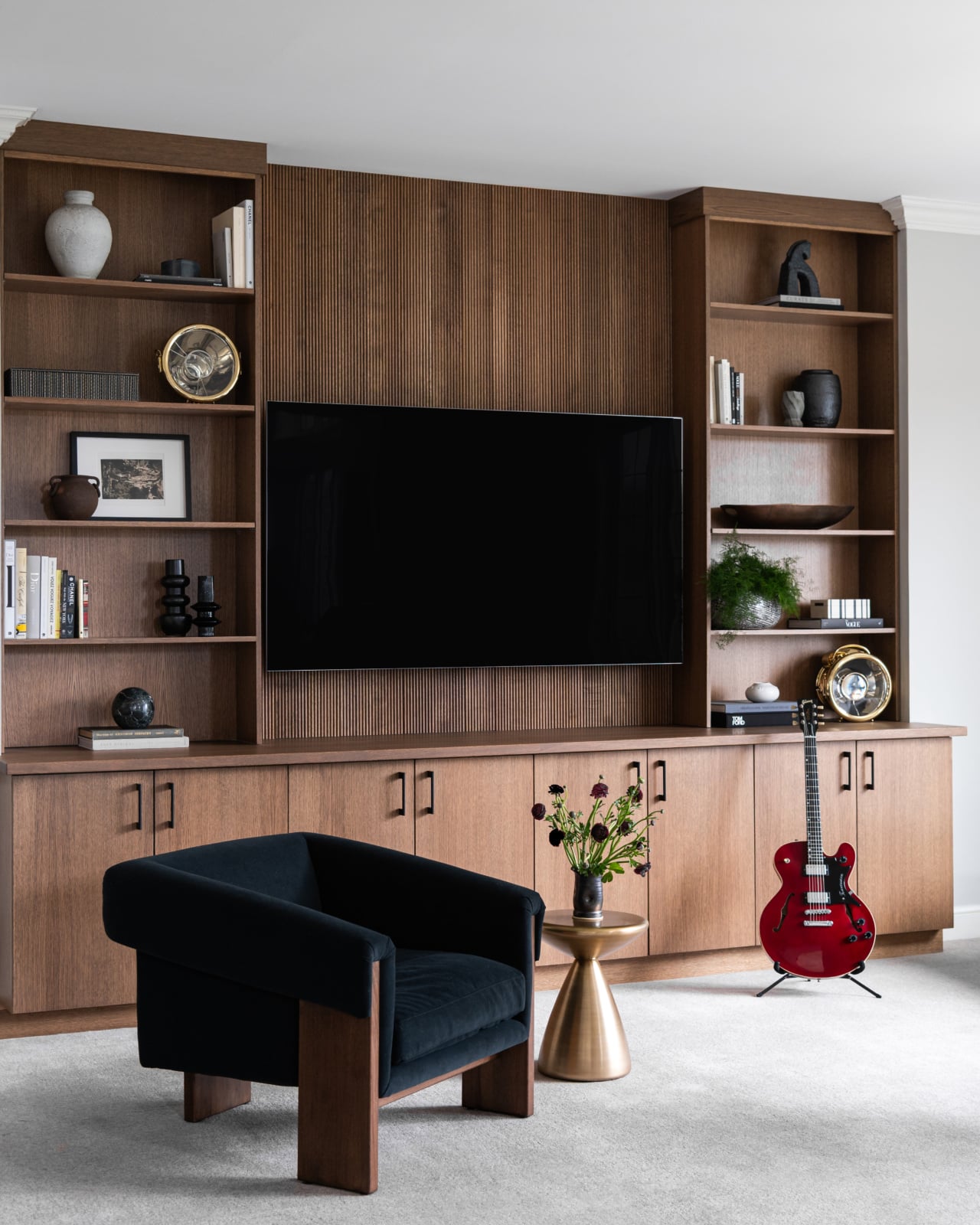
| Walnut | Deep brown, purple undertone | Rich, variable, often striking | Furniture, an island, a single wall of millwork. Use it where it can be the event. | It lightens in sunlight rather than darkening. Plan for that near big windows. |
| Maple | Pale, clean, slightly creamy | Very tight, nearly closed | Painted cabinetry and drawer boxes. It is dense and takes paint beautifully. | Blotches under stain. Specify a dye or leave it painted. |
| Cherry | Warm red, deepens with age | Fine, satiny, subtle | Furniture and traditional millwork in a house that already leans warm. | It keeps darkening for years. The sample is not the final colour. |
| Ash | Pale, neutral to blond | Open and bold, oak-like | A quieter, paler alternative when white oak feels too expected. | Supply moves around. Confirm availability before you fall in love. |
| Hickory | High contrast, blond to brown | Dramatic, wildly variable | Hard-wearing floors in a house that wants visible character. | The board to board variation is not for everyone. See a full box, not one plank. |
| Pine and cedar | Warm, yellow, ambers over time | Broad, knotty | Painted trim and paneling. Cedar for closets and covered exteriors. | Dents easily and shows every mark. Rarely the right choice stained. |
Grain and Cut Do More Work Than Species
This is the part that gets skipped, and it is the part that separates a room that looks considered from one that looks ordered. The same log yields completely different materials depending on how it is sawn.
Plain sawn is the common cut. It produces the wide cathedral arches most people picture when they picture wood grain. It is lively and it is busy.
Rift sawn is cut at an angle that yields long, straight, almost pinstripe grain with very little figure. Rift sawn white oak is the quiet material behind a great deal of the work people describe as understated. It consumes far more of the log to produce the same usable board, and it is the single most reliable way to make a large wood surface feel calm.
Quarter sawn sits between the two and, in oak, exposes the medullary rays as flecks across the board. In a Prairie School or Craftsman house that fleck is the correct historical language. In a minimal kitchen it is noise.
Scale decides which one you want. A cathedral grain that looks handsome on a sample board becomes a pattern once it runs across a twelve foot island, and pattern is a design decision you should make deliberately. In the larger rooms common through Hinsdale and the western suburbs, we specify rift cut more often than not, precisely because the surfaces are big enough that grain becomes wallpaper.
Mixing Wood Tones in One Room
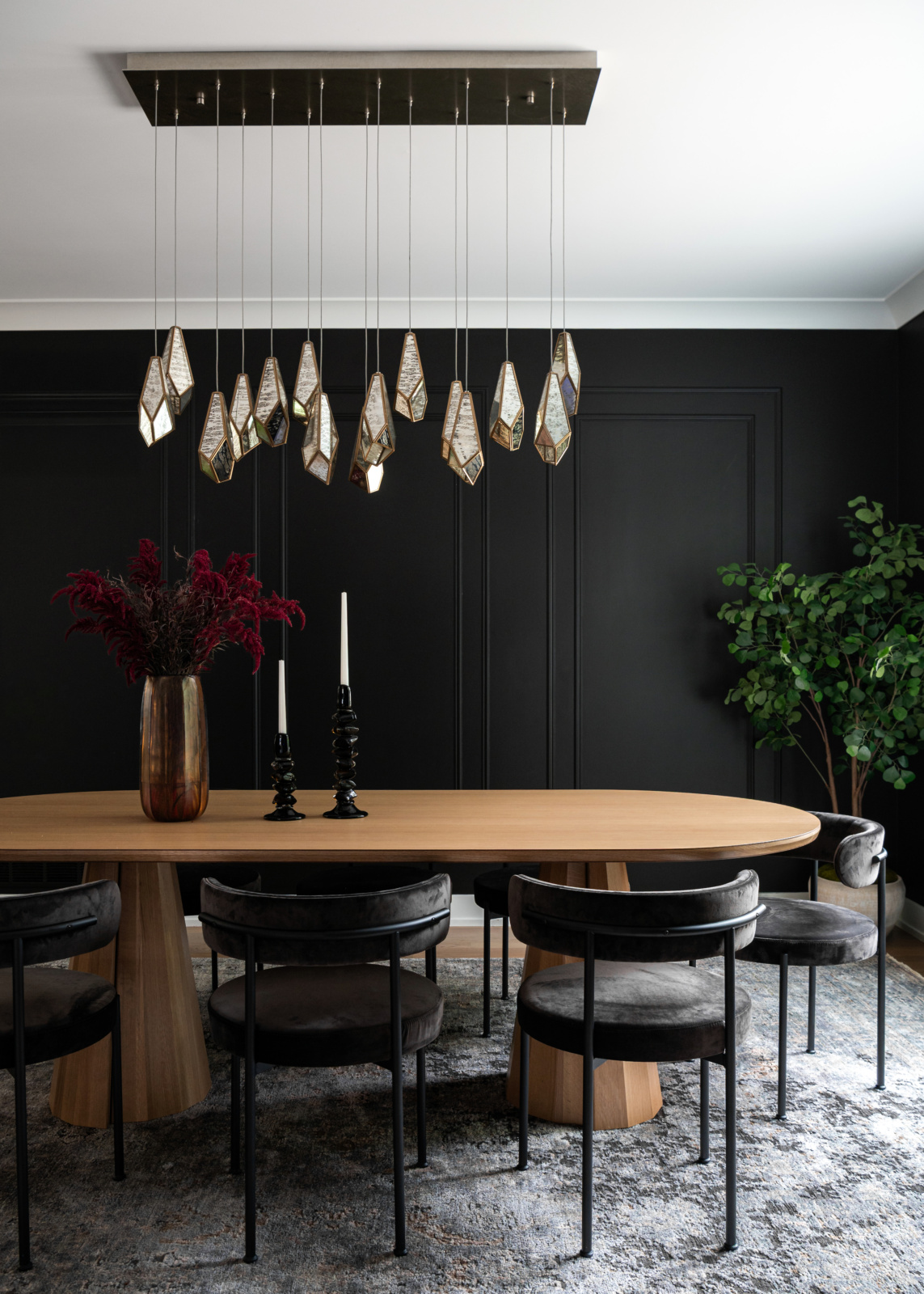
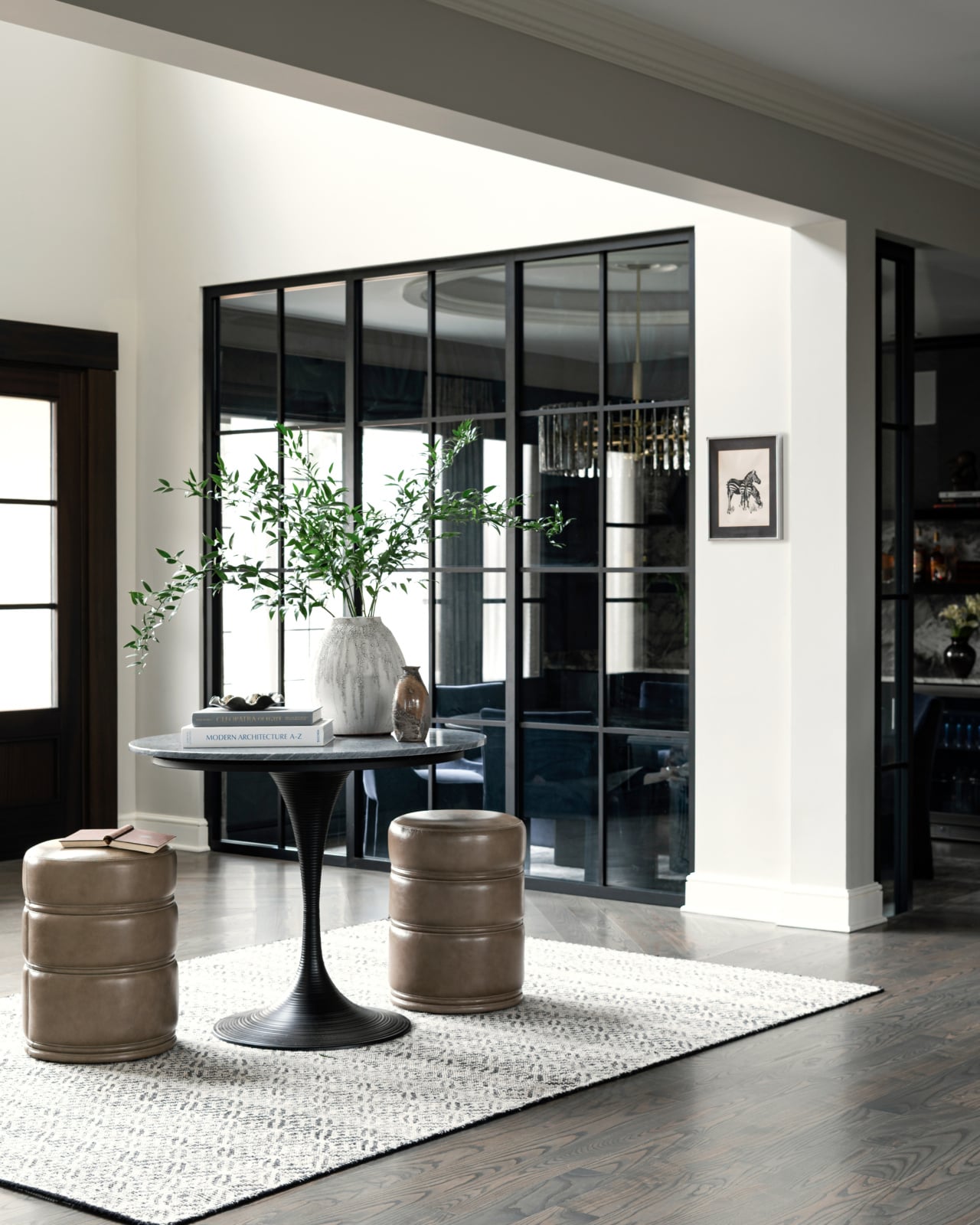
You can mix them. You should mix them. A room in which the floor, the table, the cabinetry and the frames are all the same wood in the same finish does not read as coordinated, it reads as a display floor.
The mistake people make is trying to match. Matching is nearly impossible across species and finishes, and near-matches are far more jarring than deliberate contrast. Work this way instead:
- Match the undertone, vary the value. Decide whether the room is warm or cool and hold that line. A cool grey-brown floor and a warm orange-red table will fight no matter how good either one is on its own.
- Let the floor be the anchor. It is the largest wood surface and it is the one you are least likely to change. Everything else answers to it.
- Separate similar tones. Two woods that are close but not identical need distance, or a rug, or something else between them.
- Treat three wood tones as a working ceiling in a single room. More is possible. It requires more skill and a very good reason.
- Repeat each tone at least twice. One lone dark wood object in a pale room looks like it wandered in from another house.
If you are combining periods as well as tones, our guide to mixing traditional and modern furniture covers the same problem from the other direction.
Wood on the Floor
Flooring is where wood choice has the longest consequences, because it is the surface you will replace last and the one everything else is chosen against.
In older homes the question is usually not which new wood to buy. It is what to do about the wood already there. Last year Dara worked on a home in downtown Chicago that was more than a hundred years old, converting a multi-unit building back into a single family house. When the primary bathroom was gutted, the contractors found the floor had been insulated with sand, and spent days carrying buckets of it down the stairs and out of the house. Old homes are full of surprises.
Later in that same project the homeowners chose to preserve parts of the original hardwood and replace the areas that had been damaged. That left three different species of wood across the house, some of it brand new and some of it a century old. Finding stain matches that made all of it read as one continuous floor was no small feat. The hard part is usually the interesting part.
That is the realistic version of a wood floor decision in Chicago housing stock, and it is worth knowing before you start. If your project touches the kitchen, our notes on the best floor material for a kitchen and on what to know before a kitchen redesign go further. For stairs, see how to measure for a stair runner.
Wood on Walls and Overhead
Wood above eye level behaves differently than wood underfoot, and people are consistently surprised by it.
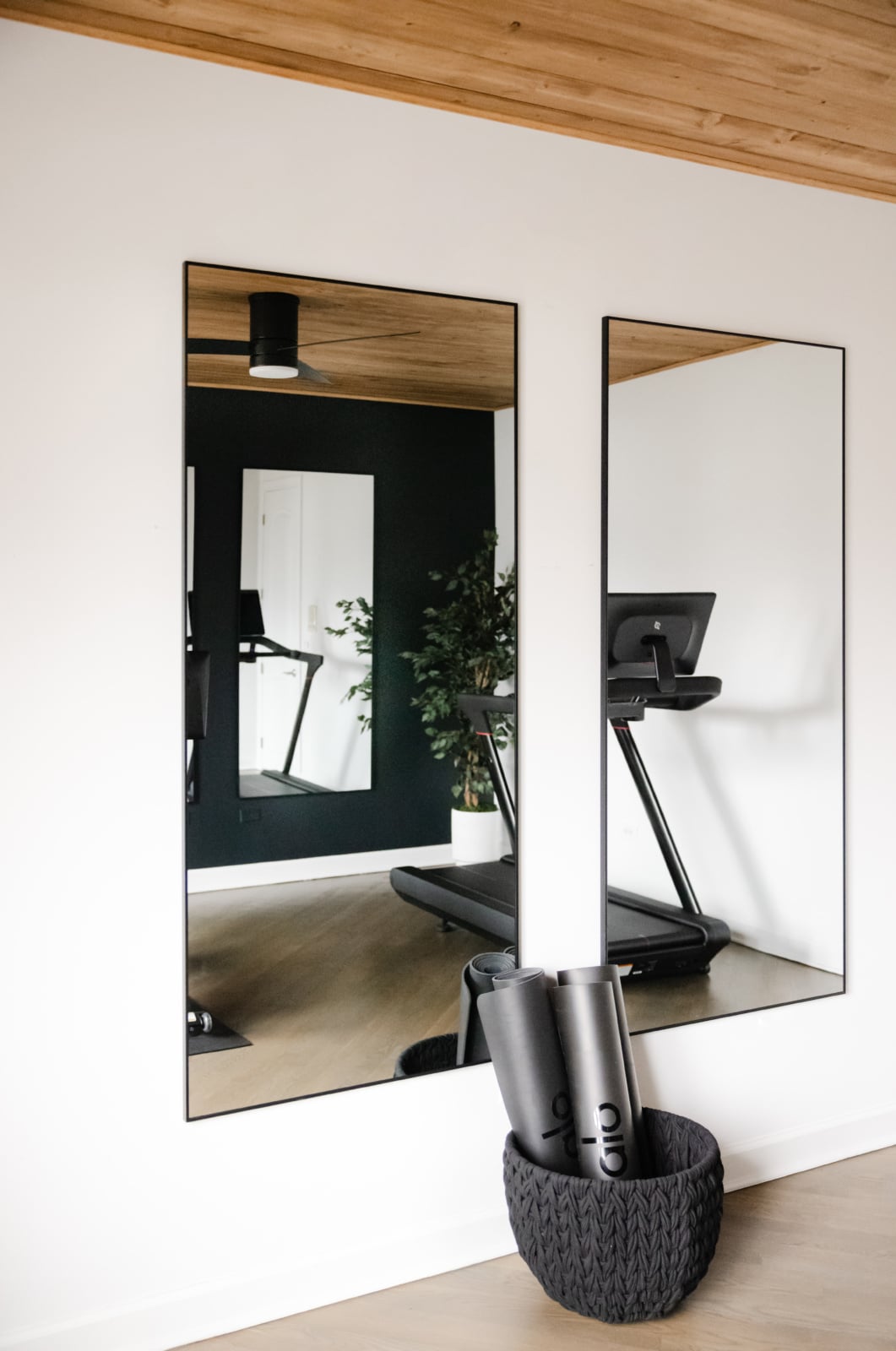
A wood ceiling changes two things at once. It absorbs light, so a room that was bright becomes noticeably softer, and it absorbs sound, so the room gets quieter and warmer acoustically. Both effects are usually welcome. Neither is reversible without starting over, so it belongs in the plan early rather than as a late addition.
Paneling is the other major move. Traditional raised panel and simple shaker panel are almost always painted softwood or MDF, where the wood is a substrate rather than a finish. Slatted and battened walls in oak or ash are a different proposition, and they are a commitment: they read as a strong architectural gesture and they date faster than a floor does.
Exposed beams, in a genuinely old house, are worth uncovering when they exist. Applied beams in a new build are a costume. We will tell you which one you have.
Millwork and Cabinetry
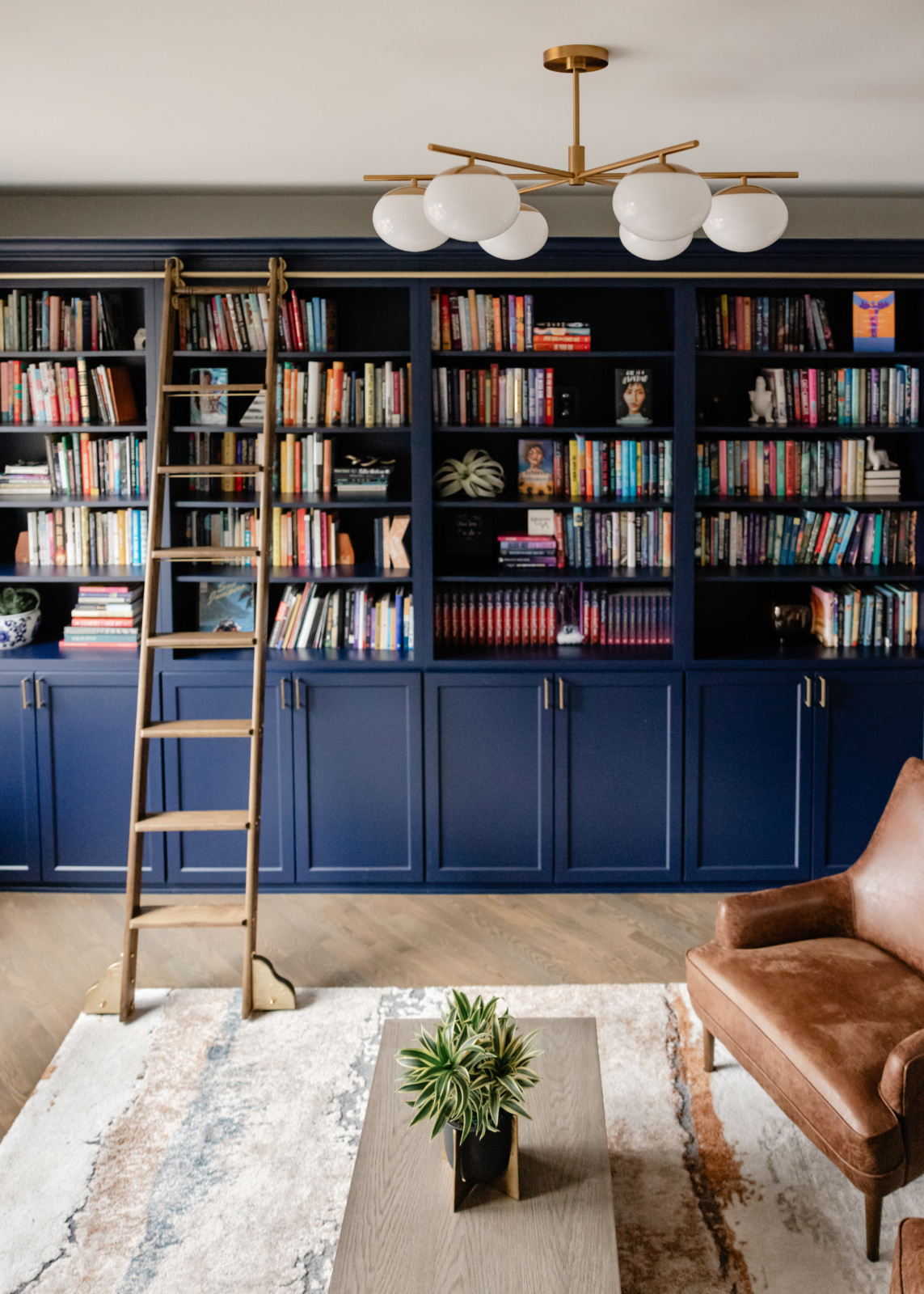
Custom millwork is where wood stops being a material you buy and becomes a thing built for your house. It is also where the difference between species really shows, because you are choosing the visible face, the interior, the edge treatment and the finish as separate decisions.
A common and sensible specification pairs a painted maple or poplar exterior with a hardwood interior, or a rift sawn white oak face with concealed hinges and a hand applied finish. A library wall, a bar, a mudroom, a run of built-ins around a fireplace: these are the places where the house starts to fit its owners rather than the other way round.
It also connects to something Dara says often about quality generally. Fast furniture is made from low-grade materials using quick construction, and that is why a sofa looks lumpy three years after it arrives. The same logic governs cabinetry. A well built cabinet box outlives several kitchens’ worth of hardware and paint.
See how this plays out across whole homes in our portfolio, or read how we sequence millwork decisions in the design process.
Finish Changes Everything
Two identical white oak boards can end up looking like completely unrelated materials depending on what goes on top. This is the stage where people are most often disappointed, because they approved a species and assumed the colour was settled.
- Clear and natural finishes keep the wood close to its raw colour, though most add some warmth. A true no-colour finish usually needs a white or neutralising component.
- Stains and dyes sit differently. Stain works on open grain species like oak and ash. Dye penetrates more evenly and is the answer for maple and cherry.
- Hardwax oils give a low sheen, a soft hand and spot repairability. They ask for periodic maintenance.
- Wire brushing and fuming change texture and depth rather than colour. Fumed oak reacts chemically with the tannin in the wood, which is why it looks unlike any stain.
- Lacquers and conversion varnishes are the durable factory option on cabinetry, harder to repair invisibly in place.
One rule with no exceptions: see a large sample of the exact species, cut and finish, in the actual room, in daylight and at night. Wood tone shifts more under changing light than almost any other material in a house. This matters most in north facing rooms, where the cool northern light pulls warmth out of everything.
On Choosing a Timeless Wood
People ask which wood will not go out of style. The honest answer is that nothing is ever completely timeless. There is always some element of a choice that shows when it was made. Styles come and go, and every time they come back something is different from the last version.
Oak is genuinely durable and it has been used for centuries, so in that sense the material is timeless. The way it is used is what dates. Orange-toned red oak with a heavy gloss reads as a specific decade. Grey-washed oak reads as another one. The wood was not the problem either time.
If you try to design every element of your home to be timeless, you will end up with a house that is entirely neutral, and neutral gets boring. Use what you love and worry less about whether it will go out of style. Life is too short. You should love your home.
A house full of the same safe choices also tends to lack the thing that makes a room memorable, which is the personality of the people in it. A home should tell your story. If it looks like everything came off one page of a catalogue, the design falls flat no matter how good the materials are.
Frequently asked questions
What is the difference between hardwood and softwood?
Hardwood comes from deciduous trees that lose their leaves, and softwood comes from conifers that keep their needles. The names describe botany, not hardness. Balsa is a hardwood and very soft, while Douglas fir is a softwood that has served as flooring for a century. Judge a board by its density, its cut and its finish rather than by the category.
What type of wood is best for interior design?
White oak is the most versatile choice for most homes, because it accepts both warm and cool stains without turning orange and it is durable enough for floors, cabinetry and stair treads. Walnut is the better choice where you want a single dramatic surface. Maple is the standard for painted cabinetry. There is no universally best wood, only the right wood for a specific surface, room and light.
Can you mix wood tones in the same room?
Yes, and you generally should. Rooms in which every wood matches read as showroom displays rather than homes. Keep the undertones consistent, either warm or cool, and vary the value instead. Let the floor anchor the scheme, give similar tones some distance from each other, repeat each tone at least twice, and treat three wood tones as a practical ceiling in one room.
Which wood is most durable for floors?
Hickory and hard maple are among the densest common flooring woods, with white oak close behind and far more flexible in how it finishes. Density is only part of it. The cut of the board, the finish system and the sheen all affect how visible wear will be. A matte hardwax oil on white oak hides daily life better than a high gloss finish on a technically harder species.
Is white oak going out of style?
White oak is very widely used right now, which is a reason to specify it thoughtfully rather than a reason to avoid it. Oak has been in continuous use for centuries. What dates is the treatment, not the species: a heavy orange gloss reads as one era and a grey wash reads as another. Choose the cut and finish carefully and the wood itself will not be what looks tired.
What wood works best in older Chicago homes?
Most older Chicago houses already have red oak floors, and the strongest move is usually to keep and refinish them rather than replace them. Where sections have been damaged or an addition introduces new wood, expect to work across several species and ages at once and to spend real effort on stain matching so the whole floor reads as one surface. Quarter sawn oak is the historically correct language in Craftsman and Prairie School houses.
Does wood furniture have to match the floor?
No. Furniture that matches the floor exactly tends to disappear against it, and near-matches look like mistakes. Aim for a clear difference in value, keep the undertone consistent, and use a rug to separate a table or case piece from a floor of similar tone.
How do I choose a wood finish?
Narrow the species and cut first, then look at large samples of the exact finish in the actual room, in daylight and under your lamps at night. Wood shifts more under changing light than nearly any other material. Consider maintenance alongside appearance: hardwax oils repair in place but want periodic attention, while conversion varnishes are more durable and harder to touch up invisibly.
Working Through It With Us
Wood decisions rarely arrive one at a time. The floor, the cabinetry, the stair treads and the furniture all get decided against each other, usually while a contractor is waiting on an answer. That sequencing is a large part of what full service design is for.
Dara Agruss Design works with homeowners across Chicago and the western suburbs on whole home renovations and furnishing projects. If you are weighing wood for a project now, get in touch and we can talk it through.