
Key Takeaways
- Interior styling is the last layer of a room: books, art, objects, lamps, flowers and textiles, placed so the room feels finished.
- A room is not finished until it is styled. When a room feels incomplete, it is usually missing accessories, not furniture.
- Objects carry biography. Books show your interests, art shows what you find beautiful, and objects show where you have been.
- Good styling starts with what you already own and adds only what the room is still missing.
- Styling is not staging. Staging removes the people who live in a house. Styling puts them on display.
- It happens on install day, after the furniture, window treatments and art are in, so the room is complete when you walk in.
Interior styling is the final layer of a room: the books, art, objects, lamps, flowers and textiles that turn a furnished room into a finished one. It comes last, after the layout, the finishes and the furniture, and it is the layer that tells anyone who walks in who actually lives there.
Most homes that feel unfinished are not short of furniture. They are short of this. A sofa, a rug and a good coffee table give you a room that works. The stack of books on that table, the painting you bought on a trip, the bowl from your grandmother’s kitchen are what make it yours. A room is not finished until it is styled, and in most of the houses we walk into across Chicago and the western suburbs, the styling is the part that never quite got done.
What interior styling actually is
Interior styling is editing and arranging. A stylist decides which objects come out, where each one goes, what sits next to what, how high the art hangs and how much empty space is left around it. It covers every surface you can put something on: shelves, mantels, consoles, coffee tables, nightstands, beds, kitchen counters and walls.
It is not shopping. The best styled rooms are built mostly from things the household already owns, with a few new pieces brought in where the room is still missing something: a lamp at the right height, a larger piece of art, a tray to gather the clutter on an ottoman. And it is not a separate project bolted onto the end of a design. In our work it is the last step of the same design process, planned from the start and finished on install day.
It is also not staging. People searching for a home stylist sometimes mean someone to prepare a house for sale, and the two jobs pull in opposite directions. Staging strips the personality out of a house so a buyer can imagine their own life there. Styling puts your life on display, because you are the one who has to live in the room.
Why a furnished room still looks unfinished
When a client tells us a room feels unfinished, the cause is nearly always the same. Accessories are what give a room the feeling of being complete, and when a room feels unfinished it is frequently because it is lacking them. The furniture can be right, the paint can be right, and the room still reads like a showroom floor or a house that has just been moved into.
The tell is usually bare surfaces and art that is too small. Empty shelves, a console with nothing on it, a single framed print floating in the middle of a large wall. The opposite problem looks different but comes from the same place: shelves filled edge to edge with matching objects bought to fill them. Both are rooms where nobody made a decision about what deserved to be seen. We go further into why the last layer separates a designed room from a furnished one in what sets apart a designer living room.
Objects carry biography
This is the part of styling that matters most, and the part a catalog cannot do. A coffee table book tells you about someone’s interests. Their art tells you what they find beautiful. The objects on their shelves tell you where they have traveled or where they come from. Put together well, a room tells a visitor who lives there before anyone says a word.
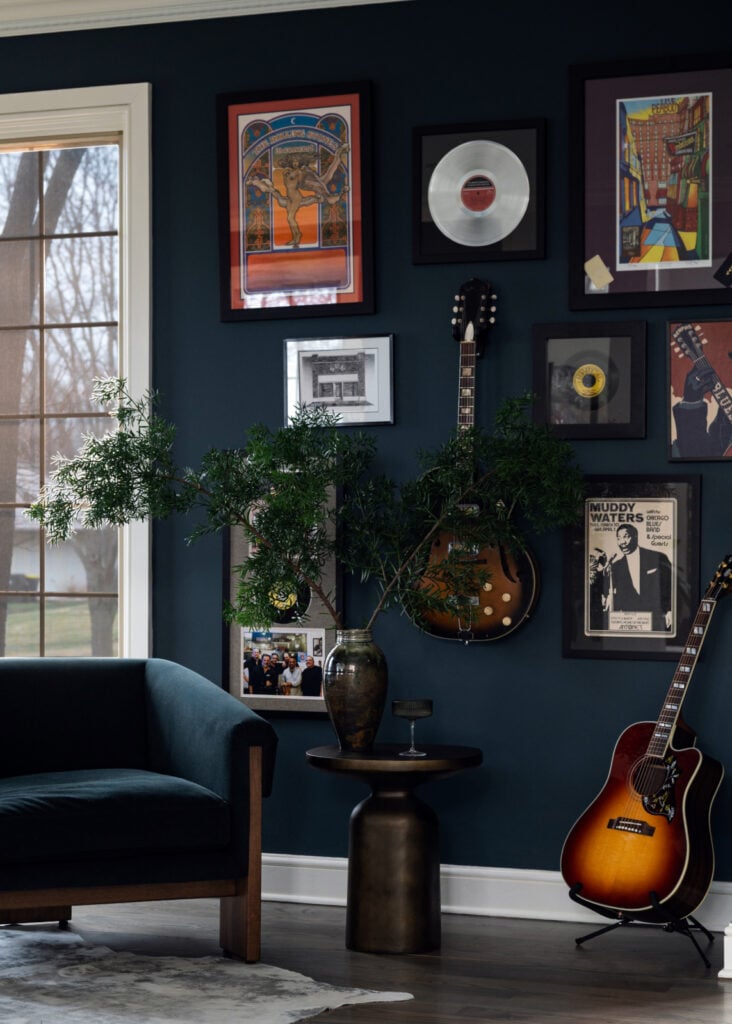
In an Oak Brook home we designed, the husband collects guitars, vintage motorcycles and automotive pieces, original headlights among them. Rather than treating the collection as accessories to be tucked away, we wove it into the design itself. The photograph at the top of this article is one wall of that house: deep blue paint, framed concert posters and records, guitars hung like art, and a chair pulled up to enjoy it. Nobody walks into that room and wonders whose house it is. The whole project is in The Modern Collector, and the house is written up in whole home design in Oak Brook.
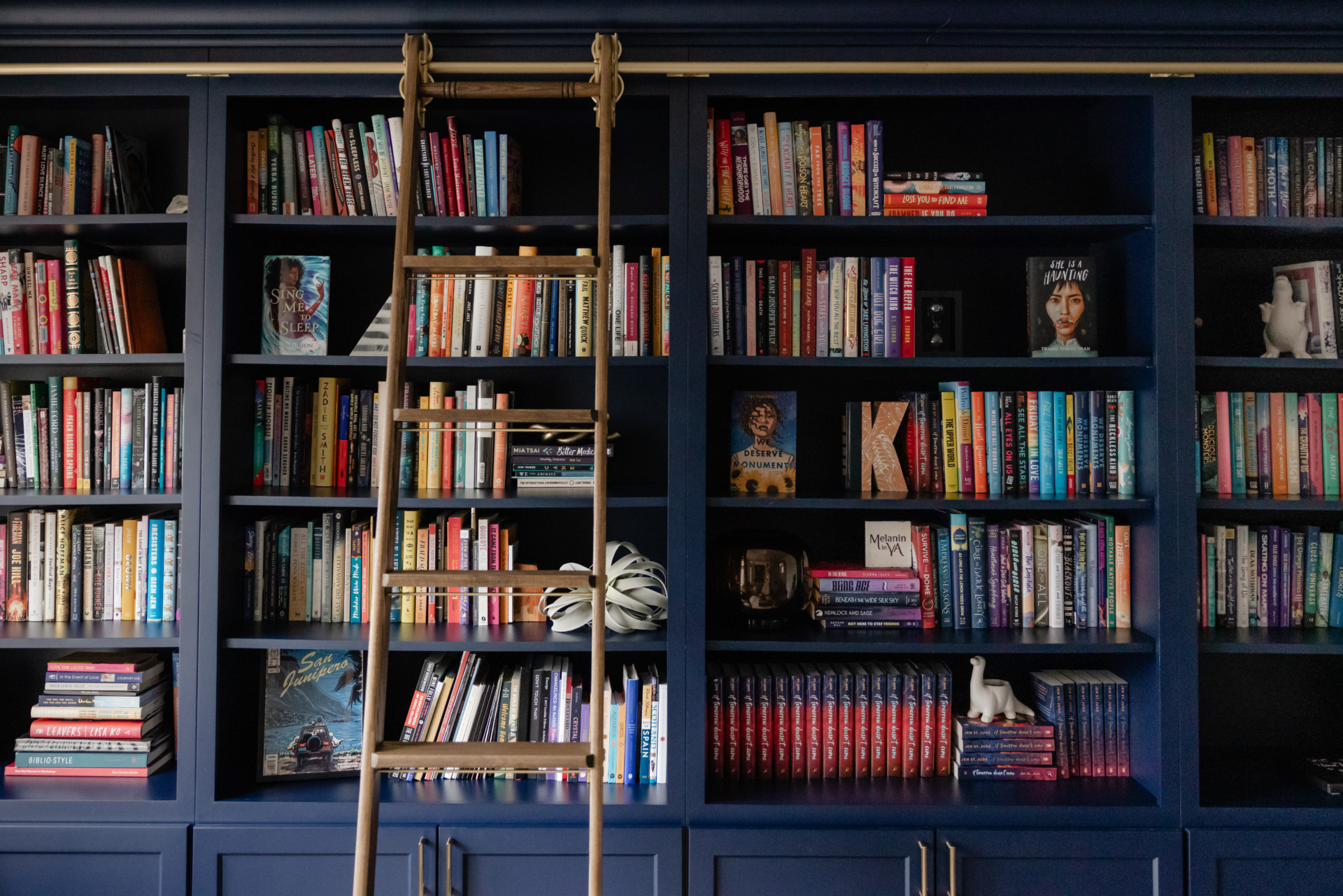
In another home, one of the clients is a writer and author with a book collection to match. We turned the formal living room into a library with floor to ceiling built-ins in a denim blue, books above and the daughter’s toys behind closed doors below. The styling there is mostly restraint: let the books be the pattern, and set a few objects and prints among them so the eye has somewhere to rest. If your shelves hold a real library, how to style bookshelves with lots of books goes shelf by shelf.
The most common mistake we see in beautiful, well finished homes is not bad taste. It is anonymity. If a room looks like everything was ordered from a single page of a catalog, the design falls flat, however good each piece is. Styling is where a home stops looking like a showroom and starts looking like you. We wrote more on why that matters in personalization in Chicago home design.
Styling, decorating and design: where each one starts
The three words get used interchangeably, and that causes confusion about what a room actually needs. They are layers of the same work, done in order, and each one answers a different question. The tinted column is the layer this article is about, and the other two run back toward the start of a project.
| The question | Interior styling | Decorating | Interior design |
|---|---|---|---|
| When it happens Where it sits in a project. |
Last, on install day. Nothing can be styled until everything else is in place. | Once the rooms exist, choosing furniture, fabric and color. | First. Layout, architecture and finishes are decided before anything is ordered. |
| What it changes The scale of the decision. |
Books, art, objects, lamps, flowers, textiles. The things you can pick up. | Furniture, window treatments, paint, rugs. | Walls, millwork, lighting plans, materials. |
| What it works with Where the material comes from. |
Largely what you already own, plus the few pieces a room is still missing. | New pieces, mostly. | Drawings and specifications. |
| What it tells a visitor The question each layer answers. |
Who lives here. What you read, what you find beautiful, where you have been. | What the room is for. | How the house works. |
| How long it lasts Permanence. |
Meant to change. Books move, art rotates, the room keeps up with you. | Years. | Decades. |
| What it cannot fix Every layer has a limit. |
Furniture at the wrong scale. Styling finishes a good plan. It cannot rescue a bad one. | A layout that does not work. | A room with nothing personal in it. |
The last row is the one people miss. Styling cannot correct a sofa that is too small for the room or a lamp that sits at the wrong height. If the scale is off on furniture or lighting, everything feels unbalanced, and no amount of accessorizing hides it. That is why we plan the layout first and style last. For a longer look at where a designer’s work begins and a decorator’s ends, see interior decorator vs interior designer.
What you bring, and what we bring
Styling starts long before install day, at the first walk through. We review everything you own. Pieces you love, or that have real quality, stay and get styled into the new design. Nothing gets replaced for the sake of replacing it.
That review is where the biography comes from. The ceramics from a trip, a grandparent’s clock, the children’s art you cannot bear to put in a drawer, a stack of books you actually read. Some of it is ready to go straight onto a shelf. Some of it needs a frame, a stand or a better spot. And some of it, honestly, is better kept in a closet and rotated in later.
What we bring is the eye and the missing pieces. That might be one large painting where three small ones were fighting, lamps that put light where the room needs it, a few sculptural objects to give a shelf of books some rhythm, or textiles to soften a room that feels hard. Words like warm and cozy come up constantly, and they mean different things to different people. For one client warm means color. For another it means a room that flows the way they live. Part of styling is learning which one you mean before anything is chosen.
Where styling shows up, surface by surface
Entries and consoles
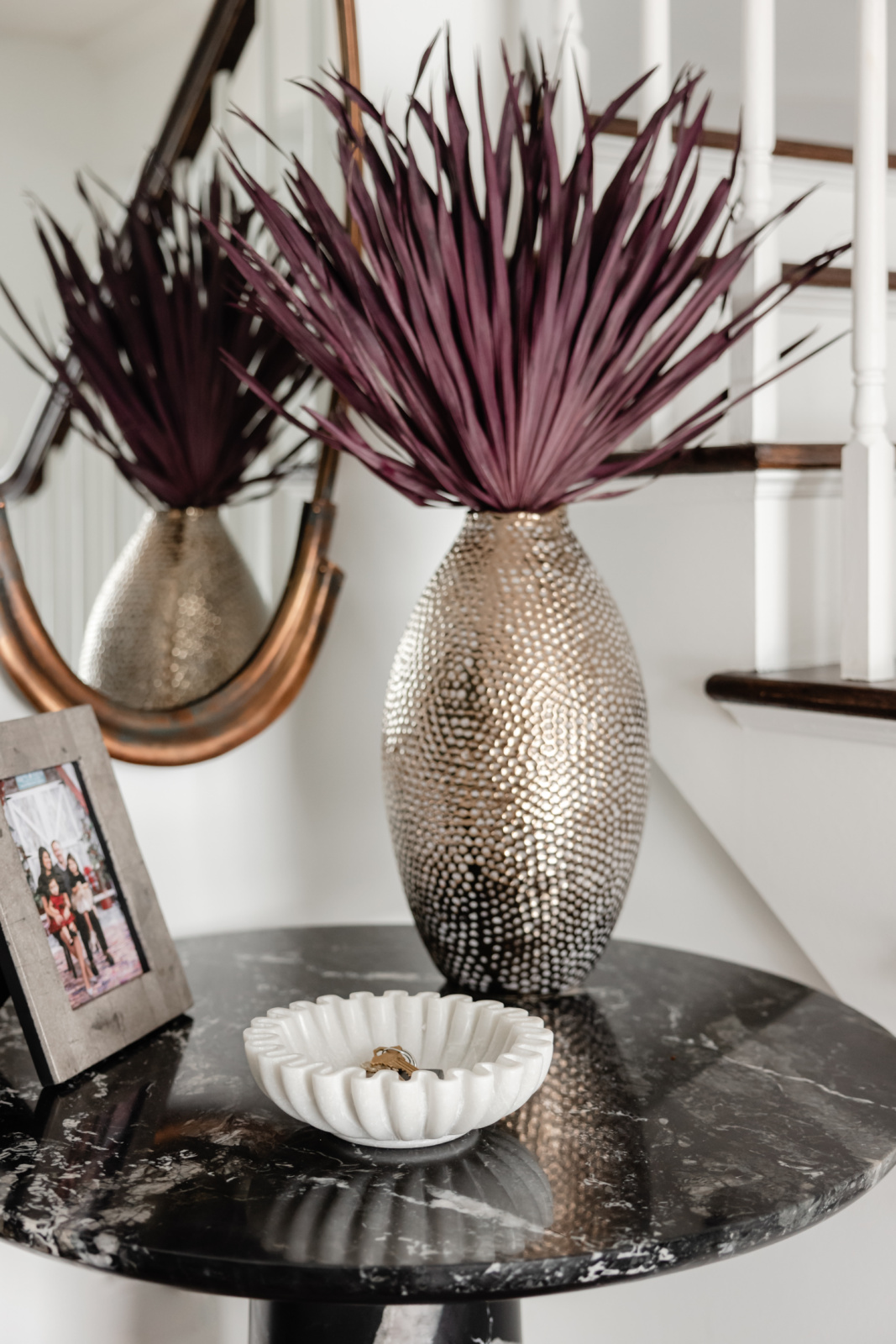
The entry is the first thing anyone sees, and a small space can carry a big amount of personality. In an Oak Brook entry with white walls that were crying out for color, we added oversized, colorful art instead of paint, tucked a petite black marble table into the corner under the stairs, hung a funky mirror above it and layered it with texture and color. The table itself holds just four things: a vase, a bowl, a branch arrangement and a family photo.
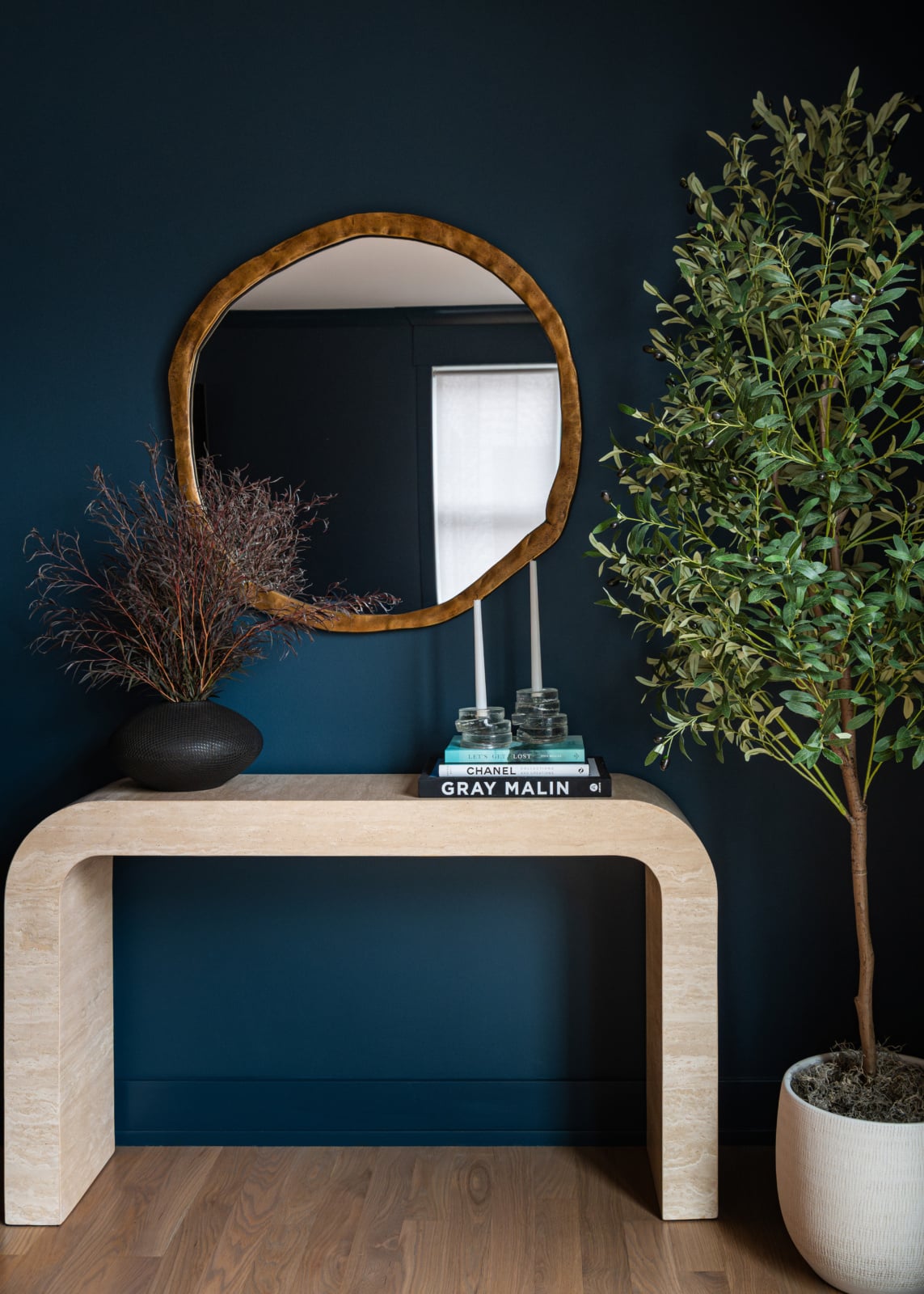
A console works the same way. Give it a mirror or art with enough presence for the wall, something tall, something low, and a stack of books to lift a smaller object. Leave space between them. The aim is a composition you can read at a glance from the front door.
Coffee tables and side tables
These are the surfaces that get used, so they have to be styled to be lived with. A tray corrals what would otherwise scatter, a couple of large format books give it height and subject matter, and one living thing, flowers or a plant, keeps it from looking staged. Leave room for a drink and a pair of feet.
Shelves and built-ins
Shelves are where styling most often goes wrong, in both directions. Built-ins that are too sparse look unfinished, and built-ins stuffed with matching objects look bought by the yard. Mix books, a few objects with some weight, and art leaned rather than hung. Vary the heights, leave some air on every shelf, and let real books do most of the work.
Bedrooms
A styled bed is mostly about proportion and layers: pillows at the right scale for the headboard, a throw that looks used rather than folded for a photograph. Nightstands need a lamp at reading height, something to read and very little else. The bedroom is the room to keep the calmest.
Children’s rooms and family spaces
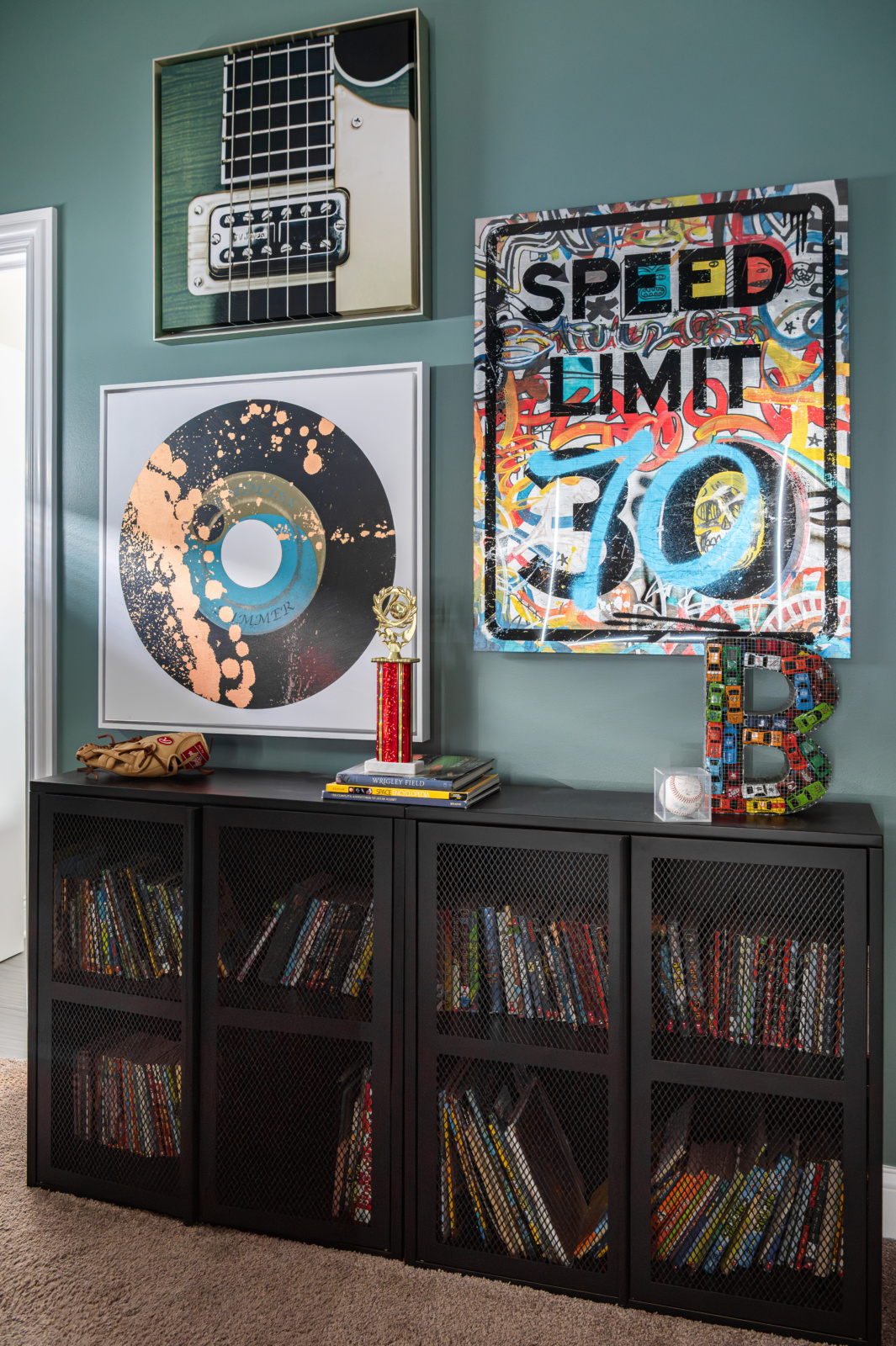
Children’s rooms should look like the child, not like a page in a catalog. Their art, their trophies and the things they are obsessed with this year deserve a real place on the wall. In one family room, bold pop art of a guitar, a vinyl record and a speed limit sign hangs above a run of black mesh front cabinets full of books, with a trophy and a mosaic letter B on top. It is personal, it is durable, and it can change as the kids do.
Install day and the reveal
In our projects, styling happens on the same day as everything else. Every piece has been received, inspected and held until the order is complete. On install day our team places the furniture, hangs the window treatments and installs the artwork. Then the last layer goes in: shelves styled, surfaces layered, art hung, greenery in place.
When you walk in for the reveal, everything is done. No boxes, no touch ups, no list of things to come back for. That is the difference between a room that has been delivered and a room that is finished. It is the same standard we hold to across a whole house, as covered in what full-service interior design includes.
Styling is not reserved for renovations either. A large share of furnishing clients are not doing any construction at all. They have just moved in, or the house has never really felt finished, or one or two rooms are underperforming. Furnishing and styling stands entirely on its own, under interior furnishings.
Styling homes in Chicago and the western suburbs
The houses here ask for different things. In Chicago‘s vintage apartments and greystones, wall space is precious, broken up by windows, radiators and original trim. Styling there means fewer, better objects, art sized to the wall that is actually available, and shelves that hold the books a smaller home cannot keep anywhere else.
In newer homes across Oak Brook, Hinsdale, Naperville, Elmhurst and Glen Ellyn, the problem flips. Two story family rooms, long built-ins and wide entries swallow small objects whole. Accessories bought at the scale of a smaller house disappear, and a big room styled with little things reads as empty. Here the art has to be larger, the objects have to have some weight, and a few generous gestures do more than many small ones.
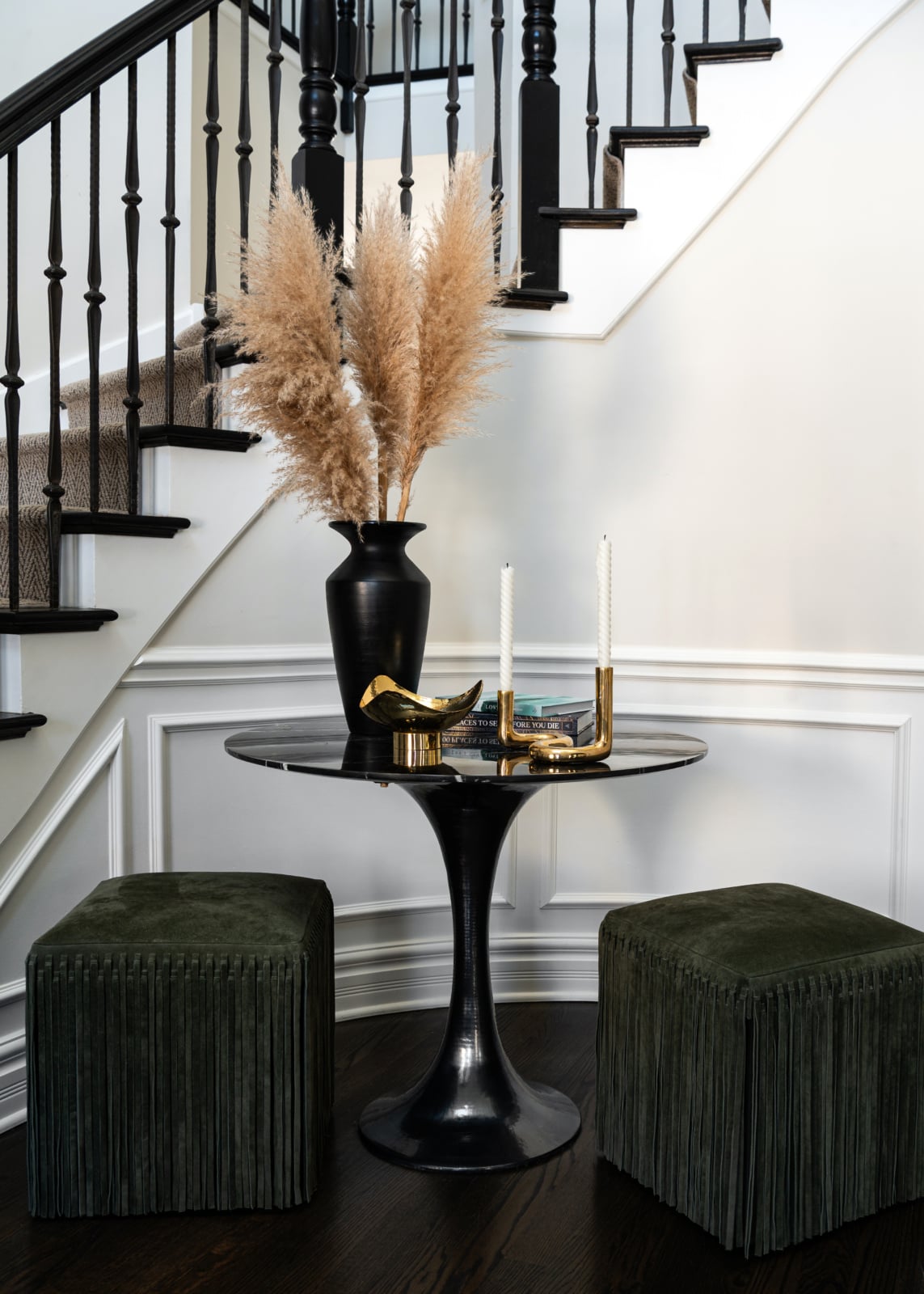
Family life shapes it too. In a Clarendon Hills home with three young boys, every piece needed to stand up to everyday use. The stair nook there holds a black pedestal table with a tall vase of pampas grass and a pair of candlesticks between two fringed ottomans: dramatic enough to stop you on the way upstairs, and nothing on it that a passing child can break. See the rest of that house in Clarendon Hills Classic.
What styling is not
Styling is not a recipe. You will find plenty of rules about groups of three and set heights, and they are not wrong, but a room styled entirely by rule looks exactly like every other room styled by the same rule. The objects should come from your life first.
It is not about everything matching, and it is not about playing it safe. Nothing is ever completely timeless, and a home styled to offend nobody ends up neutral and boring. Use what you love. Life is too short not to love your home.
And it is not permanent. The styled layer is the part of a room that is meant to change. Books move, art rotates with the seasons, a new trip brings home a new object. We explain why that flexibility is the point in furnishing a living room that lasts. If you are still working out what you are drawn to, what is my interior design style starts with what you already keep.
Frequently asked questions
What is interior styling?
Interior styling is the final layer of a room: the books, art, objects, lamps, flowers and textiles, chosen and placed so that a furnished room feels finished and personal. It comes after the layout, finishes and furniture are in place, and it is the layer that tells a visitor who lives there.
What does an interior stylist do?
An interior stylist edits and arranges the objects in a room. That means going through what you already own, deciding what stays out and where, filling the few gaps with new pieces, hanging art at the right height and scale, and layering shelves, tables and beds so each surface looks considered rather than crowded or bare.
Is interior styling the same as interior design?
No. Interior design decides the layout, architecture, lighting and finishes, and it starts first. Styling is the last step of a design project, done once the furniture is in. In our projects the two are not separate hires: styling is part of the same design, finished on install day.
Is home styling the same as home staging?
No. Staging prepares a house for sale and deliberately removes the people who live there, so buyers can picture themselves in it. Styling does the opposite. It puts your books, your art and your history on display, because the room is meant for you.
Why does my room look unfinished even with good furniture?
Usually because it is missing its last layer. A room with the right furniture and nothing on the shelves, tables or walls reads as furnished rather than finished. Accessories are what make a room feel complete, and they are also what give it personality.
Can a room be styled with things I already own?
Yes, and it should be. We review everything you own early in the process. Pieces you love, or that have real quality, stay and are styled into the new design, and new pieces are added only where the room is still missing something. Nothing gets replaced for the sake of replacing it.
How many accessories should a room have?
There is no right number. A room needs enough on its surfaces to feel lived in and enough empty space for each piece to be seen. A few objects that mean something to you will always do more than a shelf filled with things bought to fill it.
When does styling happen in a design project?
At the very end. In our projects it happens on install day, after the furniture is placed, the window treatments are hung and the art is installed. Shelves are styled, surfaces are layered and greenery goes in last, so the room is complete when you walk in.
Working with us
Dara Agruss Design is an interior design studio based in Elmhurst, working across Chicago and the western suburbs, including Hinsdale, Oak Brook, Naperville, Elmhurst, Glen Ellyn, Downers Grove, Western Springs, La Grange, Burr Ridge and Clarendon Hills. You can see more of our work in the portfolio, and everything we do under services.
If your rooms are furnished but have never felt finished, the last layer may be all they are missing. Get in touch.