
Key Takeaways
- Size the fixture to the table, not the room and not the ceiling box. The table is what it lights.
- Center it on the table. If the box is in the wrong place, move the box before the ceiling is finished.
- Hang it so guests can see each other, usually 30 to 36 inches above the tabletop under a standard ceiling.
- One chandelier is not a lighting plan. Light the walls and the art too, so the room glows rather than spotlights the table.
- Put every layer on a dimmer. The same room hosts homework in the afternoon and dinner at night.
- The fixture is the dining room’s jewelry. Choose one you love rather than the one that matches the sconces.
Good dining room lighting starts with one fixture sized and hung for the table, not the room, and then adds the light that fixture cannot give on its own: dimmable light on the walls, on the art and on the faces around the table. Get the fixture’s size, height and position right and the room feels intentional before anything else goes in. Get them wrong and no chandelier, however beautiful, will rescue it.
Most dining rooms we walk into have the opposite. A fixture hangs from wherever the builder put the ceiling box, sized to look reasonable in a store, with a grid of recessed lights around it and everything on one switch. It is bright and it is flat. This article covers how we approach dining room lighting in homes across Chicago and the western suburbs: how big the fixture should be, how high it hangs, which shape suits which table, and the layers that make a dining room feel good after dark.
Start with the table, not the ceiling
Every project we take on starts with a space plan, and dining rooms are where that matters most. If the scale is off on furniture or lighting, everything in the room feels unbalanced. In a dining room the table and the fixture are read together, as one composition, so the fixture cannot be chosen until the table is.
That means deciding the table first: its shape, its length, where it sits and how many people it seats on an ordinary night and on the biggest night of the year. Only then do we decide what hangs over it. It also means checking where the ceiling box actually is. Builders center the box on the room. Tables often end up somewhere else: pulled into a bay window, nudged toward a banquette, or floating in an open plan with no walls to center on. A fixture that hangs a foot off the center of the table looks like a mistake every time you sit down.
The fix is simple if it happens early. Moving a ceiling box before the ceiling is finished is a small job for an electrician. Moving it afterward means patching and painting a finished ceiling. That is why lighting is part of the plan from the first drawing, not the last purchase.
Lifestyle comes next. If the table doubles as the homework desk, the room needs real light at four in the afternoon as well as a low glow at eight. If there are young children, a fixture of fragile glass hung low over the table is a risk nobody needs. The lighting should be designed around the people who use the room, not around a photograph of it.
How big the fixture should be, and how high it hangs
There are rules of thumb for both, and they are a good place to start. They are not a good place to finish.
Width and length
A round fixture usually starts at about half to two thirds of the table’s width. A linear fixture over a long table starts at about two thirds of the table’s length, so the light reaches both ends without the fixture hanging past the people sitting there. Size it to the room instead, as many calculators do, and a big room with a modest table ends up with a fixture that overwhelms the table it is meant to light.
Height above the table
With a standard eight foot ceiling, the bottom of the fixture usually sits 30 to 36 inches above the tabletop, and a little higher for each additional foot of ceiling. The number matters less than the test behind it: seated guests should see each other clearly, under or through the fixture. If people are talking around the crystals, it is too low. If the light feels like it belongs to the ceiling rather than the table, it is too high.
Where the rules stop working
The rules assume every fixture of the same size looks the same size, and it does not. An open ring reads far lighter than a solid drum of the same diameter, because the eye sees the air through it. A cluster of glass pendants reads lighter still. A fixture of leather, fringe or dense metal reads heavier than it measures and should usually go smaller than the formula suggests.
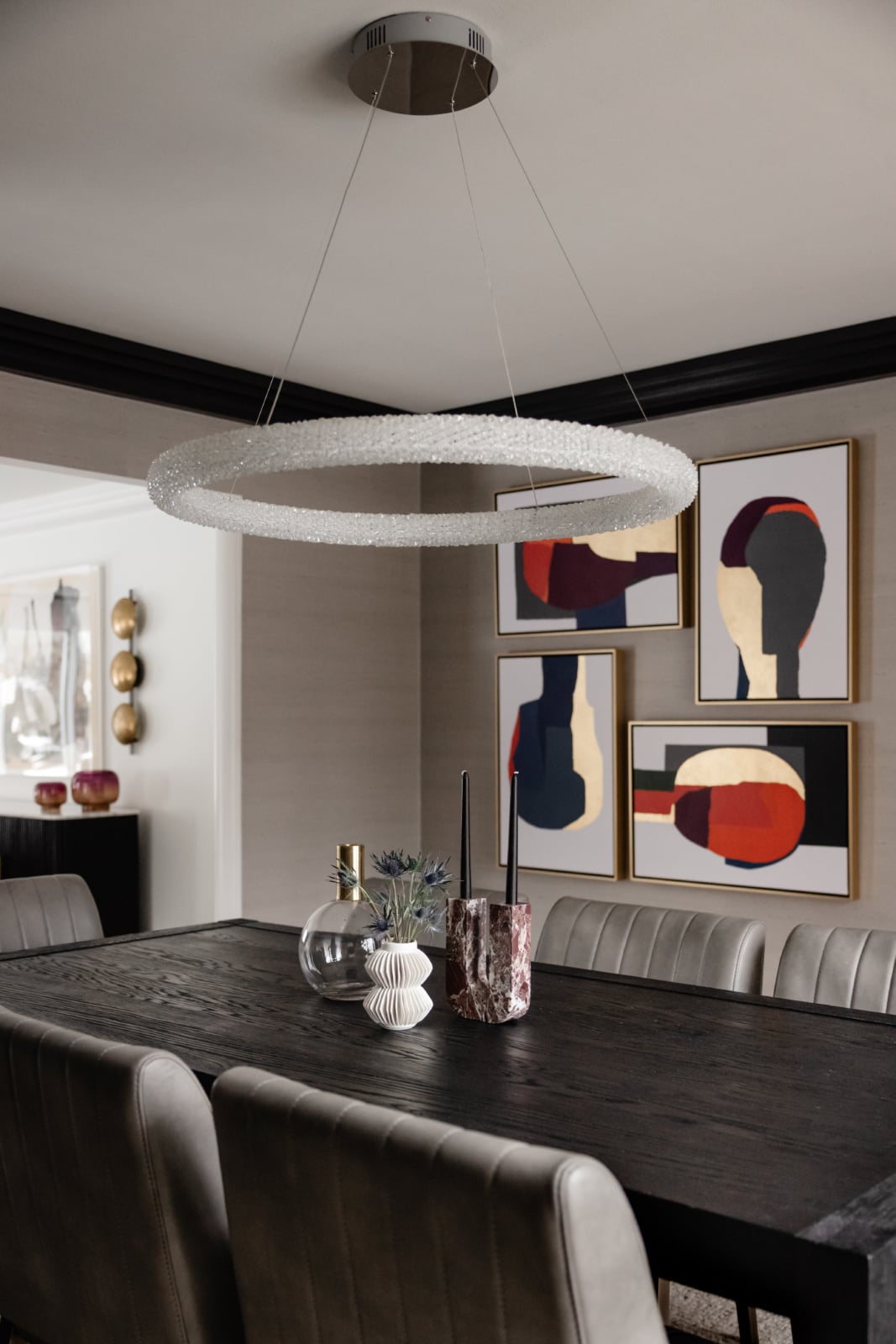
In an Oak Brook dining room that had to work as a family friendly space for a household with young children, the fixture is an open ring. It spans a long table and holds its own in the room, but because you see straight through it, it never crowds the people sitting underneath. See the rest of that house in Oak Brook Modern Refresh.
Choosing the fixture: shape follows the table
Dining room lighting ideas tend to be presented as a style choice: modern or traditional, brass or black. The more useful question is what the table needs. The chart sets the four main families side by side. The tinted row is the one we see go wrong most often.
| The question | Round chandelier or drum | Linear fixture | Cluster of pendants | Sculptural statement piece |
|---|---|---|---|---|
| The table it suits Shape follows the table, not the ceiling. |
Round and square tables, and short rectangles. | Long rectangles and ovals, where one round fixture leaves both ends dark. | Round tables, and rooms where pendants can hang at more than one height. | Any table, as long as everything else in the room steps back. |
| The ceiling it needs Height decides how much fixture the room can hold. |
Comfortable at standard heights; a drum needs a little more room above. | Works at standard heights and keeps sightlines open across the table. | Best with height to spare, and spectacular in a tall or two story space. | Depends on the piece. Fringe and leather read heavier than they measure. |
| The light it gives faces What people actually see at dinner. |
Even and soft, especially through a shade or diffuser. | Even along the whole table, so nobody at the end sits in shadow. | Sparkle more than light. Usually needs help from the walls. | Often the least light of the four. It is there to be looked at. |
| Visual weight How big it looks, which is not how big it is. |
A solid drum reads heavy; an open ring of the same size reads light. | Light from the side, substantial from the end of the room. | Light, because the eye reads glass and air rather than a mass. | Heavy. Size it smaller than the rules suggest. |
| The mistake we see most What makes a dining room look unplanned. |
Sized to the room or the ceiling box instead of the table. | Too short for the table, so it reads as an afterthought. | Hung so low that guests talk through the glass. | Competing with a bold wallcovering and a busy rug for the same attention. |
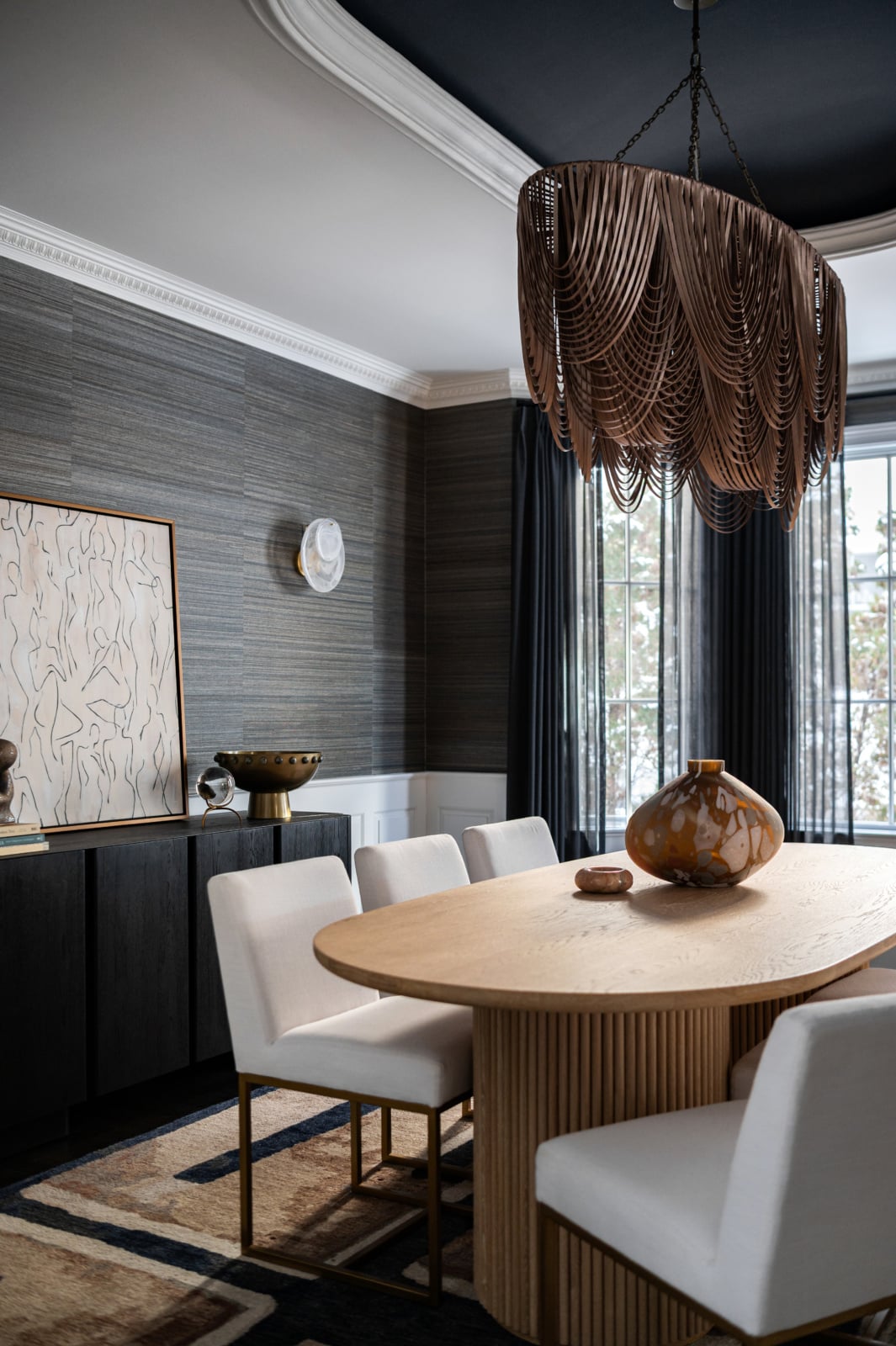
The statement piece deserves the most care, because it is the one most likely to fight the rest of the room. In a Clarendon Hills home with three young boys, the dining room got a leather chandelier for warmth and edge, set against grasscloth wallpaper for texture. Both are strong, and they work because they speak the same language: natural, tactile and warm. Put the same chandelier against a high gloss patterned wallpaper and the two would compete for every glance.
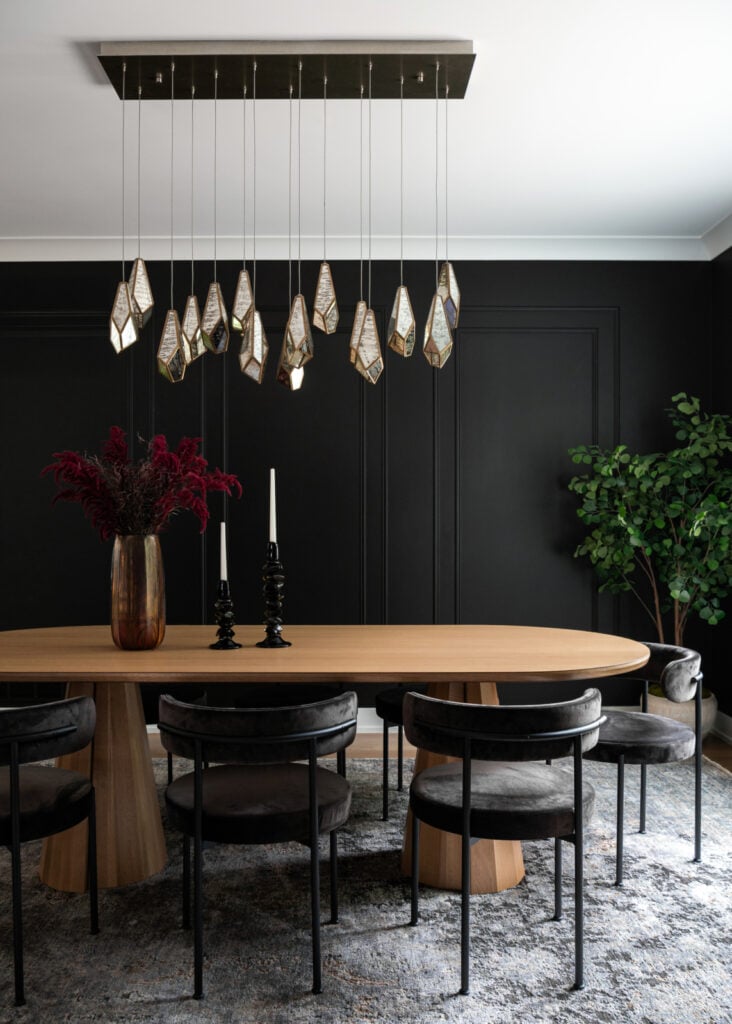
The fixture at the top of this article is the other kind of statement: a linear run of crystal pendants hung at staggered heights over an oval table, against black paneled walls. In that home, lighting became one of the defining elements of the whole project. It works over a long table because it follows the table’s shape, and it works against black walls because black lets the crystal be the only thing that shines. The project is Modern Farmhouse to Parisian Chic.
One fixture is not a lighting plan
The most common dining room we see has a chandelier doing all the work, usually at full brightness. It lights the tabletop, leaves the walls in shadow, and puts everyone at the table under a glare. A dining room needs layers, the same as every other room, and they should all be on dimmers.
The first layer is the fixture over the table. Dimmed down, it is the mood of the room, not its work light. The second is ambient light on the walls. If there are recessed lights, they belong near the walls washing them, not in a grid over the table casting shadows on faces. We wrote about that in recessed lighting layout, and the principle, light the walls and not the floor, applies more in a dining room than anywhere. The third layer is accent light: a picture light over the art, light inside a glass front cabinet or a bar, a pair of sconces either side of a sideboard. The fourth is the one people forget, which is candles. Candlelight is the most flattering light there is, and a room designed for dinner should leave space for it.
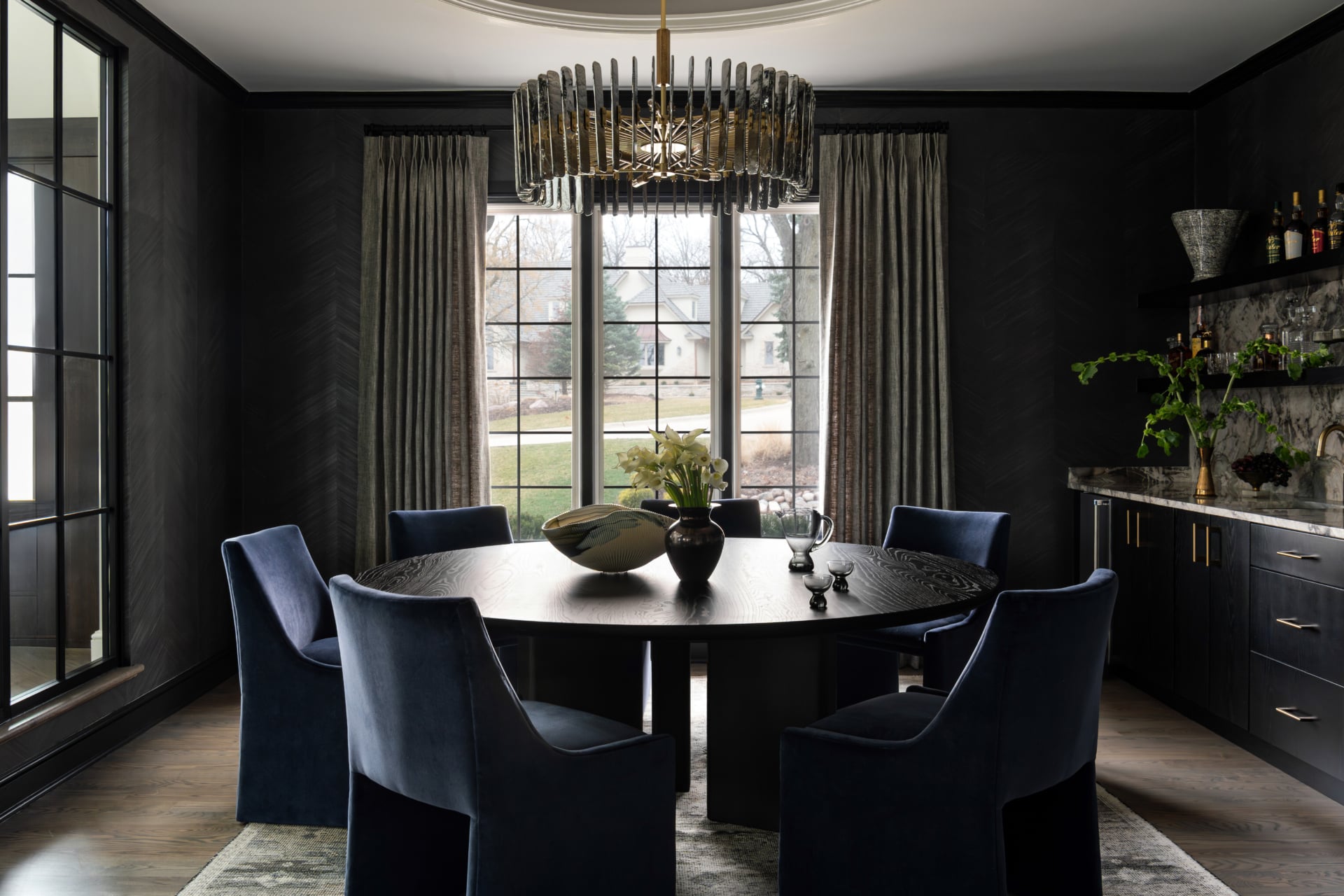
Dark rooms show this most clearly. In an Oak Brook dining room with deep, saturated walls, the walls absorb light rather than bouncing it, so the crystal drum over the table cannot carry the room alone. The bar nook beside it, an underused corner turned into a bar during the project, gives the eye a second place to land. See more of that house in The Modern Collector.
Color, finish and how light behaves in the room
Light does not stop at the fixture. Every surface in the room either absorbs it or sends it back, and the finishes decide how much light the room actually feels like it has. Dark matte walls drink light in. Metallic finishes, lacquer and wallcoverings with a sheen return it. In one dining room with a black tray ceiling, we used a grasscloth wallcovering with a subtle sheen so the light from the fixture bounces around the room instead of disappearing into the dark ceiling above it.
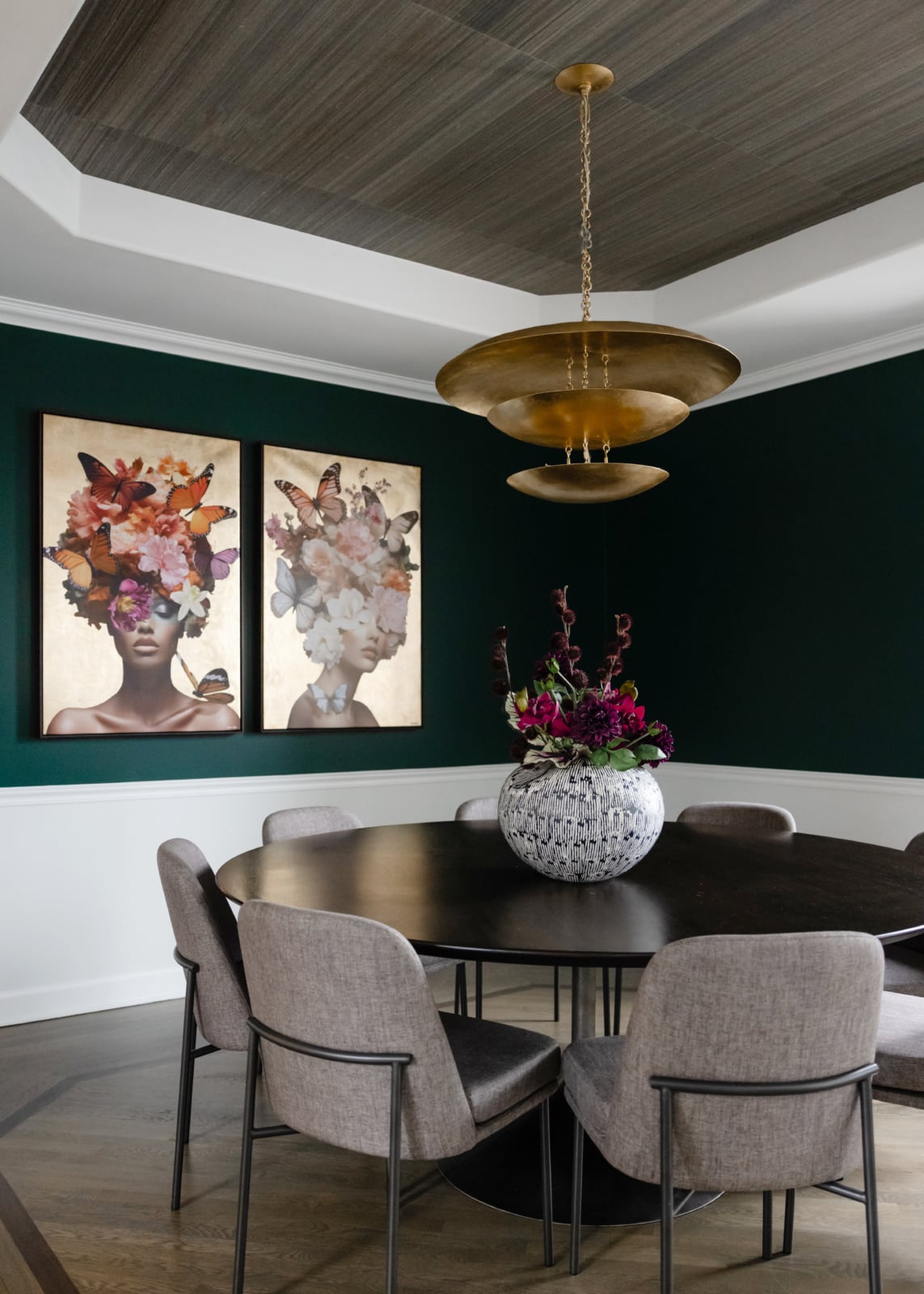
The fixture’s own finish matters too. In one family’s dining room, we kept their existing table and chairs and painted the walls a striking hunter green. A brass chandelier went in to brighten the room and bring warmth against the green, and art with gold leaf picked up the brass. Nothing in that room is new except the walls, the light and the art, and it feels like a different room. It is part of Literary Retreat.
One thing we steer clients away from is the matching set: the chandelier, the sconces and the pendants all from the same collection, in the same finish, bought together. It is the fastest way to make a dining room look ordered from one page of a catalog. A dining room should tell you something about the people who eat in it. The fixtures in a room should relate to each other, in metal, in shape or in scale, without being identical. Rich woods and warm metals covers how to mix finishes so they look chosen rather than accidental.
Open plan dining: let the light define the room
In an open plan, the dining area has no walls to tell you where it begins. The fixture does that job. A light centered over the table, with a rug sitting under the pulled out chairs, does more to make a dining area read as a room than any partial wall or half height divider.
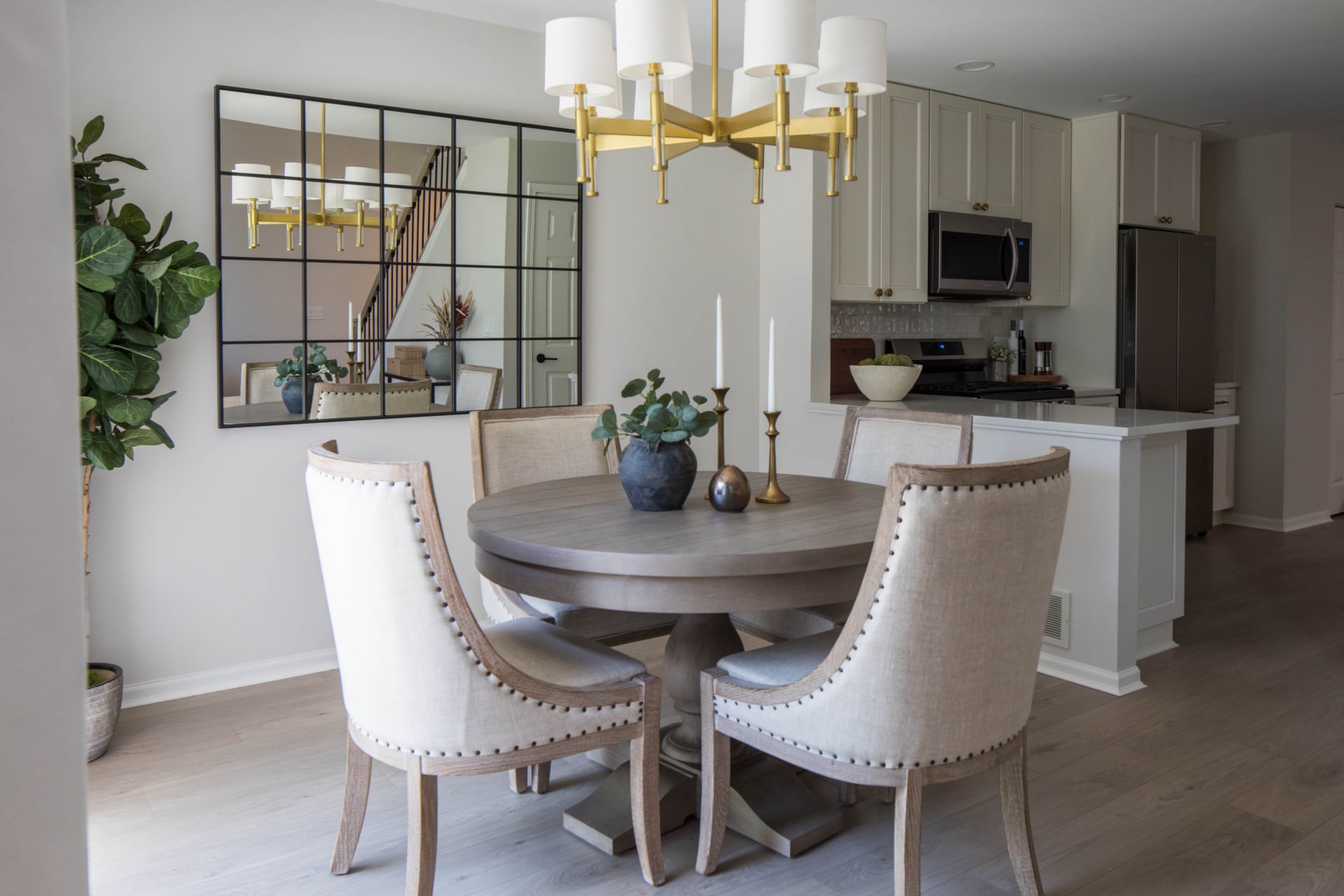
The challenge is the kitchen next door. Its pendants and the dining fixture are seen together from almost everywhere, so they need to relate without matching. A shared metal, a shared shape or a shared scale is usually enough. The dining fixture should be the clear centerpiece of its own zone, often a little more decorative than the kitchen lights, which have a working job to do. In one townhouse where we took out the old fluorescent kitchen lighting and replaced it with recessed light, a brass candle style chandelier over the round table gives the dining area its own identity, even though the kitchen is right behind it.
Dining room lighting in Chicago and western suburbs homes
The houses here ask for different things. In Chicago‘s vintage apartments and greystones, the dining room is often a pass through between the living room and the kitchen, with plaster ceilings and sometimes an original medallion. The box is usually where it was a hundred years ago, positioned for a table that is long gone. Getting the fixture centered on today’s table takes planning, because cutting into old plaster is not something to do twice.
The older homes of Hinsdale, Western Springs and La Grange tend to have true formal dining rooms, often with modest ceiling heights and bay windows. A bay is beautiful, and it tends to pull the table toward the window and away from the center of the room. In the Clarendon Hills dining room above, the table sits into the bay and the chandelier follows the table, not the room. Ceilings there also limit how much fixture the room can hold, which makes visual weight more important than diameter. We wrote more about working with that housing stock in old house interior design in Hinsdale.
Newer homes in Oak Brook, Naperville, Burr Ridge and Elmhurst have the opposite problem: tray ceilings, tall rooms and open plans where a standard fixture disappears. Those rooms can carry far more fixture than the rules suggest, and a tray ceiling is an opportunity, painted dark or papered to frame the light. They also tend to be open to a kitchen or a two story entry, so the dining fixture has to hold its own against the lights around it. Inside a whole home project in Oak Brook shows how one of those houses came together.
Decided early, installed last
Most of what makes dining room lighting work is invisible by the time the room is finished. Where the box sits. Whether the ceiling can carry a heavy fixture. Which lights share a dimmer and which get their own. Whether there is power on the wall for a picture light or a pair of sconces. Each of those is simple in a drawing and disruptive in a finished room, which is why lighting goes into our design process at the space planning stage.
Our clients are not sourcing fixtures or chasing an electrician. We specify the lighting along with the table, the seating, the wallcovering and the drapery, so every piece is chosen in relation to the others, and we coordinate with the electrician so the boxes, dimmers and circuits are where the design needs them. Then everything is installed and the room is styled, down to the candles on the table. Interior styling covers that last layer, and mixing and matching dining chairs covers the seating under the light.
Lighting is one part of a dining room. Dining room design is where these projects usually begin, with the plan, the table and the light worked out together.
Frequently asked questions
What is the best lighting for a dining room?
Layers, all on dimmers. A fixture sized to the table gives the room its center and its mood, recessed or ceiling light washes the walls, and accent light picks out art, a bar or a cabinet. A single chandelier on its own almost never gives a dining room enough light, or the right kind.
What size chandelier do I need for my dining table?
Size it to the table, not the room. A round fixture usually starts at about half to two thirds of the table’s width, and a linear fixture at about two thirds of its length. Treat those as a starting point: an open ring can go larger than a solid drum, and a heavy sculptural piece should go smaller.
How high should a light hang over a dining table?
With a standard eight foot ceiling, the bottom of the fixture usually sits about 30 to 36 inches above the tabletop, a little higher for each additional foot of ceiling. The real test is sightlines: seated guests should see each other under or through the fixture, never have to talk around it.
Should a dining room light be centered on the table or the room?
On the table. The ceiling box is often centered on the room, but the table frequently is not, especially in a bay window, beside a banquette or in an open plan. Moving the box before the ceiling is finished is simple. Living with a fixture that hangs off center from the table is not.
Do you need a dimmer on dining room lights?
Yes, on every layer. The same room is used for homework at four in the afternoon and dinner at eight, and only dimmers let it do both. A fixture that cannot be turned down is the most common reason a dining room feels harsh at night.
Can you use recessed lighting in a dining room?
Yes, as a supporting layer. Recessed lights work best washing the walls and lighting art, not aimed down over the table, where they put shadows on faces. The fixture over the table and light on the walls are what make a dining room feel good.
Should dining room lighting match the kitchen pendants?
Relate, not match. In an open plan the dining fixture and the kitchen pendants are seen together, so they should share something, a metal, a shape or a scale, while the dining fixture stays the clear centerpiece of its own zone.
What color light is best for a dining room?
Warm. A warm white light flatters faces, food and wood, and it suits a room used mostly in the evening. Keep every fixture in the room the same color of light, because a cool bulb beside a warm one makes both look wrong.
Working with us
Dara Agruss Design is an interior design studio based in Elmhurst, working across Chicago and the western suburbs, including Hinsdale, Oak Brook, Naperville, Elmhurst, Glen Ellyn, Downers Grove, Western Springs, La Grange, Burr Ridge and Clarendon Hills. You can see more of our work in the portfolio, and everything we do under services.
If your dining room looks fine at noon and flat at dinner, the lighting is usually why. Get in touch.