
Key Takeaways
- The best green living rooms commit. Green on the walls, the ceiling and the trim feels calm and enveloping. Green on one wall looks like a decision left halfway.
- Choose the green for the light, not the paint chip. Smoky deep greens work almost anywhere, sage needs a bright room, and greens that lean blue need warmth around them.
- Sage is often best on millwork, where it calms a busy room, rather than as a safe neutral on every wall.
- Green does not have to be paint. A glazed green tile fireplace or a green room seen from the living room can carry the color.
- Warm materials make green sing: cognac leather, dark wood, brass, cream upholstery and pink in the art.
- Use the green you love. Nothing is completely timeless, and a room designed never to date usually ends up as beige as the one it replaced.
The best green living room ideas have one thing in common: they commit. Green taken over the walls, the ceiling and the trim makes a living room feel calm, rich and enveloping, while green on a single accent wall, or a pale sage chosen because it seemed safe, usually leaves the room looking undecided. The right green for your room depends on its light and on what you love, not on the color everyone is painting this year.
This article covers why so many green rooms disappoint, a Clarendon Hills sitting room we wrapped in green and why the ceiling went green too, how sage, smoky, hunter and blue-leaning greens behave, and what to pair with them. It draws on projects across Chicago and the western suburbs, including the room at the top of this page.
Why so many green rooms fall flat
Green has been the color people ask about for a few years now, and most of the advice comes down to the same formula: a soft sage on the walls, white trim, white ceiling, a few plants and some natural wood. It is pleasant. It is also the same room you have seen a thousand times, and in a lot of living rooms it barely reads as green at all. On a gray winter afternoon, a pale sage in a north-facing room looks like tired gray.
The other common answer is the accent wall: one green wall behind the sofa or the fireplace, with everything else left as it was. That rarely works either. A single colored wall tends to look like a decision you stopped halfway through, and it divides the room rather than defining it.
A home should tell your story and who you are. If a living room looks like someone ordered everything from a single page of a catalog, the design falls flat, and a green room built from a formula falls flat in exactly the same way. The rooms that work are the ones where the green was chosen for that house, that light and those people, and then used with conviction.
Inside a Clarendon Hills sitting room wrapped in green
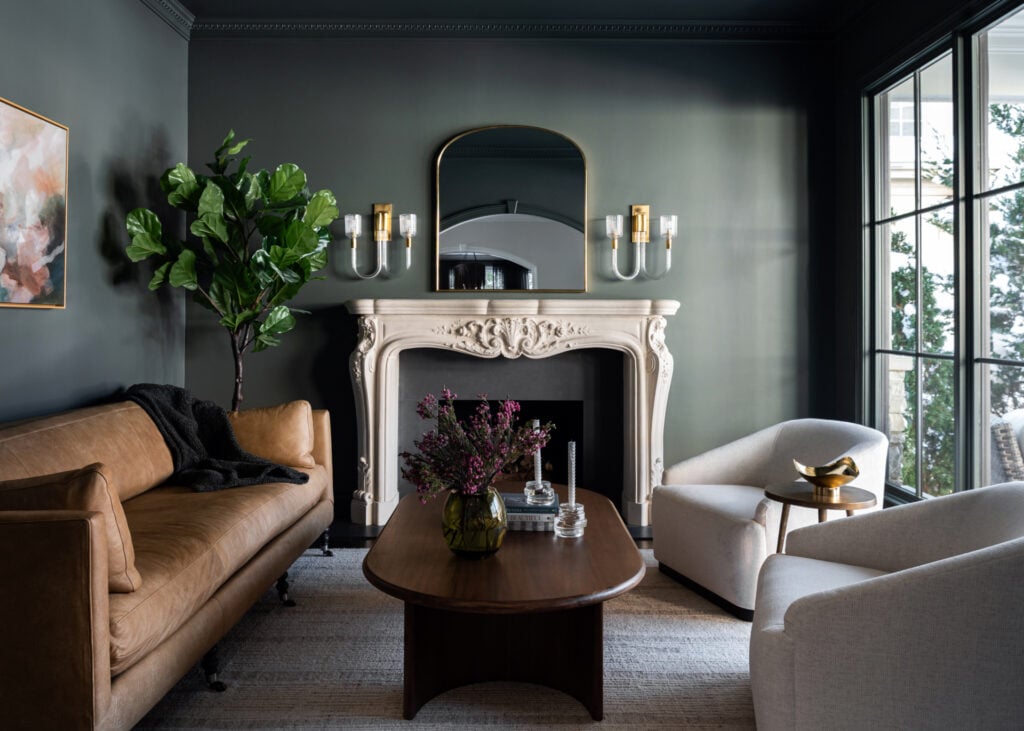
The room at the top of this page is the sitting room of a Clarendon Hills home we took from traditional to fresh, functional and family-focused. Before, it had an existing fireplace with a carved mantel that simply blended into beige surroundings. A beautiful piece of architecture, and nobody noticed it.
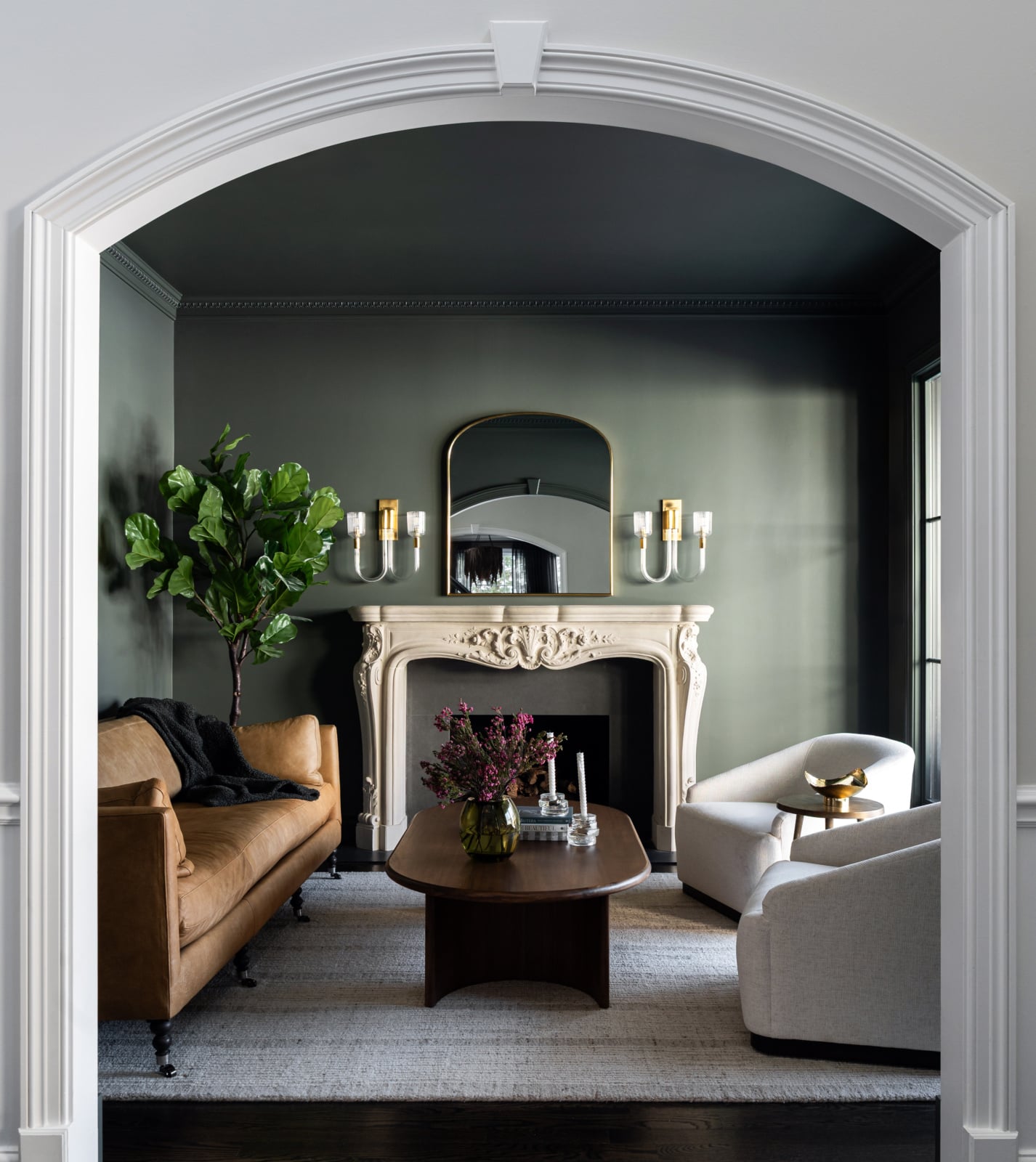
We wrapped the walls, the ceiling and the trim in a rich, smoky green. With no white edges left to frame it, the cream mantel became the focal point of the room, and the space gained contrast, character and a real sense of intimacy. The arched mirror and the pair of brass sconces above the fireplace now read as a composition rather than as things hung on a wall.
Why the ceiling and the trim went green too
Painting a ceiling and its crown molding the same color as the walls, sometimes called color drenching, is what separates a green room from a room with green walls. White trim draws a line around every wall and window, and a white ceiling sits on top like a lid. Take those lines away and the room becomes one continuous space. The eye stops jumping between edges and settles on the things that matter: the fireplace, the art, the people in the room.
It also flatters older architecture. The arched opening into this room stays crisp white on the hall side, so stepping through it feels like stepping into somewhere different, and the green makes the carving on the mantel stand out more than any white wall could.
Furniture chosen for three young boys
This is not a museum room. The family has three young boys, so every piece in the house had to balance style with real-life function and stand up to everyday use. A cognac leather sofa, two curved cream armchairs and an oval wood coffee table give the green the warmth it needs, and they were chosen to wear well, not to be protected. A lot of the success of a green room comes from what sits in front of the green.
Sage, smoky, hunter or blue-green: which green suits your room
Green covers more ground than almost any other color, from soft sage that is nearly a neutral to hunter green that is nearly black, to jades that cannot decide whether they are blue or green. They behave very differently in a living room. The chart compares the four families we use most. The tinted column is the one we reach for most often in a living room, because it is the most forgiving of the light.
| The question | Sage and soft gray greens | Smoky deep green | Hunter and forest green | Greens that lean blue |
|---|---|---|---|---|
| How it reads The first impression from the doorway. |
Quiet and soft. Close to a neutral, which is both its appeal and its risk. | Enveloping and calm. Rich without being loud, and it makes the room feel held. | Confident and traditional. A color with real presence that wants to be the point of the room. | Cool and changeable. It shifts between blue and green depending on what sits beside it. |
| The light it suits North, south and evening light. |
Bright, south or west facing rooms. In low north light it can slide toward gray. | Almost any. It is meant to be deep, so low light makes it moodier rather than duller. | Rooms you use most in the evening, under lamps and a warm overhead fixture. | Sunny rooms, where warm light keeps it from turning cold. |
| Where it works best Walls, ceiling or millwork. |
Cabinetry and built-ins, where it gives a busy room a calm backdrop. | Walls, ceiling and trim together, so there are no white edges to stop the eye. | Walls above a white wainscot, or a library or dining room seen from the living room. | Tile, upholstery and accents, as much as paint. |
| What it pairs with Materials and colors that make it sing. |
Warm wood, cream, natural linen and a touch of black. | Cognac leather, cream upholstery, brass and pink or coral in the art. | Brass, gold leaf, dark wood and crisp white trim. | Warm wood, rust, ochre and plenty of brass. |
| What goes wrong The mistake we see most. |
Chosen because it feels safe, so the room ends up as neutral as the beige it replaced. | Stopped at the walls, with white trim and a white ceiling that cut the room into pieces. | Paired with matching green everything, so the room looks themed rather than lived in. | Put in a dim room with cool bulbs, where it goes flat and chilly. |
Light is the deciding factor more often than taste. A green chosen under bright showroom lights or from a small chip can look completely different on four walls of a north-facing room in January. We look at large samples in the actual room, morning and evening, before anything is decided, and we wrote more about how cool light changes color in paint colors for north facing rooms.
Sage green living rooms: put the soft green where it earns its place
Sage is the green most people start with, and it can be lovely. The trouble is that it is usually chosen as a safe neutral rather than as a color, which is how a living room ends up as quiet as the beige it replaced. Where sage really shines is on millwork.
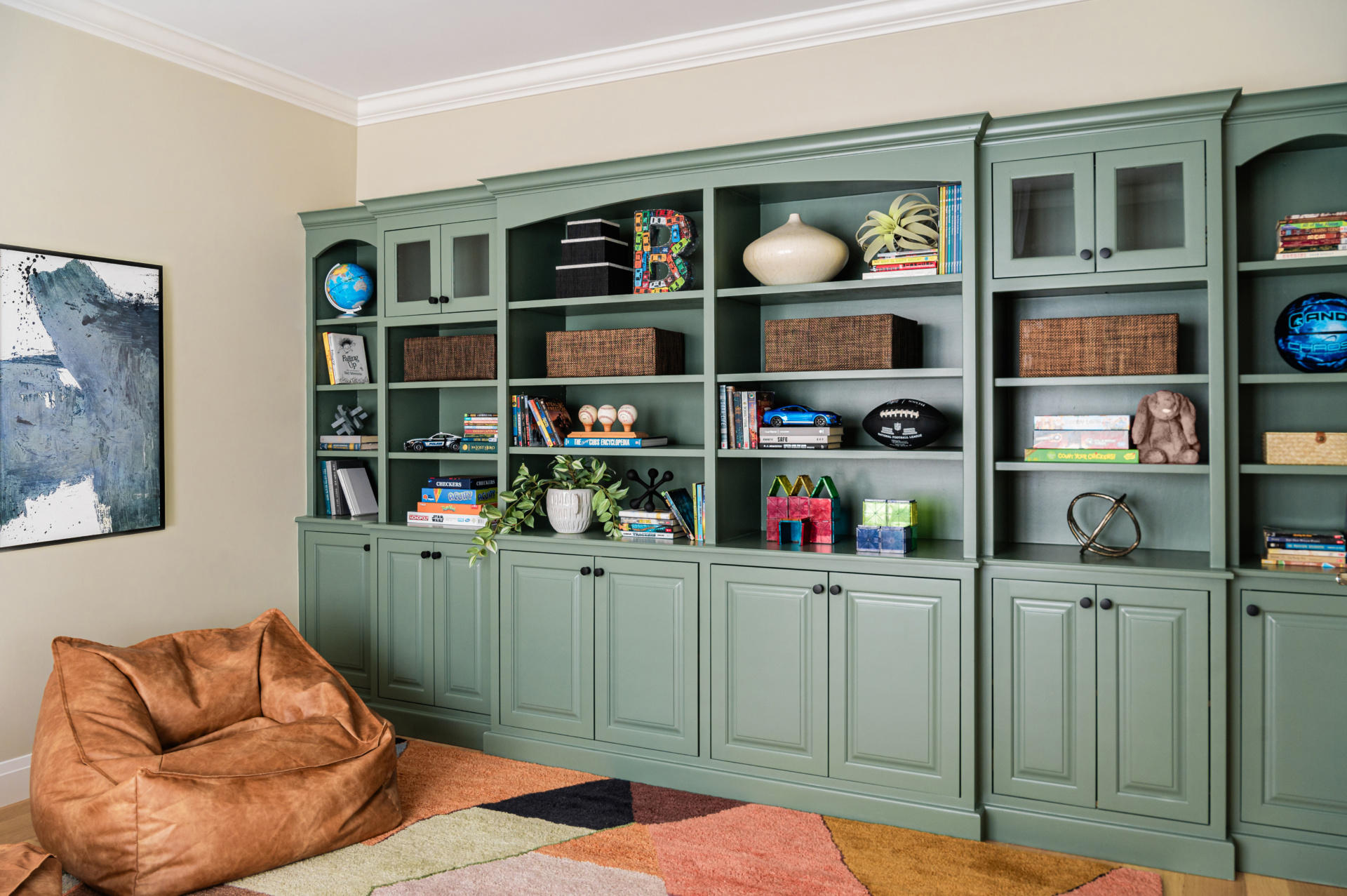
In one family home, the built-ins in the playroom were given a fun refresh with a soft sage green paint. Against cream walls, the green gives a wall full of books, baskets, games and a globe a calm backdrop, and it pulls together a colorful geometric rug and a cognac leather bean bag that would otherwise compete. The same approach works in a living room with living room built-ins: green cabinetry adds color without committing every wall to it.
If you want sage on the walls, give it a bright room, ideally south or west facing, and pair it with warm wood, natural linen and a touch of black so it reads as a color rather than a pale gray. Building the rest of the room around it is the subject of how to create a decorating palette.
Dark green living rooms: go deeper than feels comfortable
Most people who want a green living room choose a shade or two lighter than the one they actually love, because the dark version feels like a risk. It is usually the lighter one that disappoints. A deep green makes a living room feel intimate rather than small, it gives pale furniture and art something to stand out against, and in the evening, under lamps, it glows. It is the same argument we make for blue living rooms and for a dark home office: commit to the depth, then light it well.
Green in tile, not paint
Green does not have to come from a paint can. In Oak Brook, a house with beautiful bones had three existing fireplaces that all felt more traditional than the clients wanted, and the original palette leaned heavily neutral and gray. We reimagined each fireplace with new stone and tile, giving each one its own character, and introduced color to bring warmth, depth and personality into the rooms.
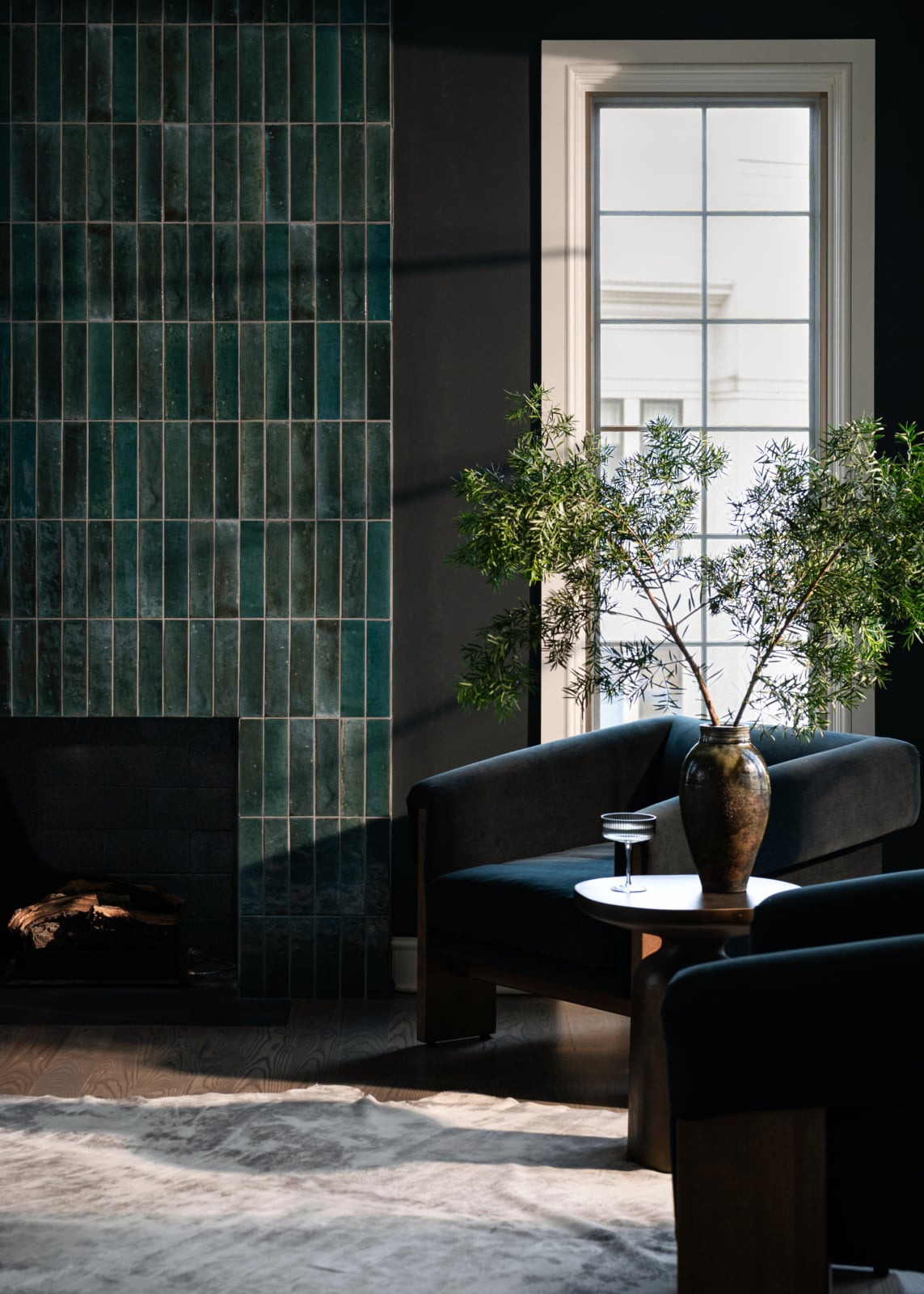
In one living room, dark green glazed tile runs in tall vertical stacks from the hearth to the ceiling. The glaze catches the light from the tall window beside it, so the green shifts through the day, and dark velvet armchairs and olive branches finish the corner. It gives the room a deep green anchor without painting a single wall. You can see the rest of the house in The Modern Collector, and how we held the project together in whole-home interior design in Oak Brook.
If you are thinking about changing a fireplace rather than repainting around it, how to update a stone fireplace covers the options.
Let the green carry into the next room
A green living room does not have to stand alone. In many homes the living room looks straight into the dining room, and a green seen through a doorway can do as much for a living room as green on its own walls.
In one home, about twenty years old, we kept the existing dining table and chairs and painted the walls above the white wainscot a striking hunter green. A tiered brass chandelier brightens the room and adds warmth, and two portraits with gold leaf applications bring depth and character. From the rooms around it, the dining room reads as a jewel box, which is exactly what a deep color in a connected room should do. We covered choosing that chandelier in dining room lighting, and more of the house is in Literary Retreat.
The rule of thumb we follow is that connected rooms should relate, not match. A living room in a smoky green and a dining room in hunter green, or green in one room and a warm neutral with brass in the next, feel like parts of the same house. Every room in the same green feels like a theme.
What to put with a green living room
Green is generous with company, but it does its best work beside warm materials. The pairings we come back to most:
- Cognac and tan leather. The warm brown balances green’s coolness, so each makes the other look richer. The Clarendon Hills sofa is the clearest example.
- Dark wood. Walnut and stained oak tables ground a green room and keep it from feeling cool.
- Brass and gold. Sconces, a chandelier or a picture light add a glow that deep green reflects beautifully.
- Cream and ivory upholstery. Pale pieces stand out against deep green and keep a dark room light where people actually sit.
- Pink, coral and blush. In art, flowers or a cushion, a soft pink against green is one of the most flattering combinations there is.
What to avoid is green everywhere: green walls, green sofa, green cushions and a green rug. Patterns and objects should bring other colors in. And the things that make a room personal matter as much as the paint. A coffee table book tells you about someone’s interests, their art tells you what they find beautiful, and the objects they keep tell you where they have been. A green room full of those reads as a home, which is what interior styling is for.
Warm is a feeling, and so is green
When clients ask for a warm living room, we do not hand them a formula, because warm is a feeling and it means different things to different people. For some it means color. For others it means a room that flows and makes sense for how they live. Green is the same. For one family, a green living room means a deep, enveloping room for evenings by the fire. For another, it means sage built-ins and a bright, easy room for kids. Our job is to find out which before anything is chosen.
That is also why we never tell anyone to pick a green because it will last. Nothing is ever completely timeless: the material may endure, but the way it is used always shows when it was chosen. If you design every room to be timeless, every room ends up neutral and, frankly, boring. Use the green you love. Life is too short not to love your home.
Green living rooms in Chicago and the western suburbs
The houses here shape how green behaves. In the older homes of Clarendon Hills, Hinsdale, Western Springs, La Grange and Elmhurst, living rooms often have original millwork, arched openings, crown molding and carved or painted mantels. Wrapping those rooms in a deep green celebrates the architecture rather than hiding it, and the trim becomes texture instead of outline. We wrote more about that housing stock in old house interior design in Hinsdale.
In newer homes in Oak Brook, Burr Ridge and Naperville, living rooms are often larger, with tall ceilings and big windows onto wooded lots. A deep green brings a big room down to a human scale and makes it feel intimate, and with trees outside the windows, green inside reads as a continuation of the view rather than a statement against it.
In Chicago greystones and vintage condos, light is often limited by neighboring buildings, and that is where pale greens struggle most. A deeper, warmer green holds its color in low light, and it looks wonderful against original woodwork.
Part of the whole room, not just the paint
A green living room is a series of decisions that have to agree with one another: the green itself, how far it goes, the lighting that makes it glow, the furniture in front of it and the art on it. Choosing the paint first and solving the rest later is how rooms end up feeling unfinished.
That is why color goes into our design process alongside everything else: the space plan first, then how the family actually lives, with kids, pets and allergies all shaping the selections, then color, furniture, lighting and art chosen together. We coordinate the painters and any construction, such as a new tile fireplace, and then install and style the room in a single day. Living room design explains what that looks like for a living room.
Frequently asked questions
What is the best green for a living room?
The best green is the one you love that also suits the light in your room. A smoky, deep green is the most forgiving choice in a living room because it works in almost any light and gets richer, not duller, in the evening. Soft sage suits bright rooms, and hunter green suits rooms used mostly at night.
Should the ceiling be green too?
In a room you want to feel enveloping, yes. Taking the green over the walls, the ceiling and the trim removes the white edges that cut a room into pieces, so the space feels calmer and the architecture stands out. A white ceiling over deep green walls can feel like a lid.
Is a dark green living room too dark?
Not if it is planned with the lighting. Deep green makes a room feel intimate rather than small, especially in the evening. Lamps at several heights, a warm overhead fixture and pale upholstery keep it glowing rather than gloomy.
What colors go with green in a living room?
Warm materials do the most for green: cognac leather, walnut and oak, brass and cream upholstery. Pink, coral and blush in the art or flowers look especially good against deep green. Avoid matching the green elsewhere in the room, which makes it look themed.
Is sage green still in style?
Nothing is ever completely timeless, and chasing whatever will never date tends to produce a neutral, boring room. If you love sage, use it, and use it where it works best, on cabinetry and built-ins or in a bright room. You should love your home more than you worry about it going out of style.
Does green work in a north-facing living room?
Yes, but choose a deeper, warmer green. North light is cool and even, so pale greens can turn gray in it. A smoky deep green or a green with some yellow in it holds its color, and warm lamp light finishes the job.
Is a green accent wall a good idea?
Usually not. One green wall tends to look like a decision you stopped halfway through. If you want green, commit to the room, or put the green into something with substance, such as a tiled fireplace, built-ins or upholstery.
What furniture goes with green walls?
Furniture with warmth and texture. A leather sofa, cream or ivory upholstery, dark wood tables and brass lighting all read beautifully against green. Durable fabrics matter if there are kids or pets, because a deep green room is a room the family will want to live in.
Working with us
Dara Agruss Design is an interior design studio based in Elmhurst, working across Chicago and the western suburbs, including Hinsdale, Oak Brook, Naperville, Elmhurst, Glen Ellyn, Downers Grove, Western Springs, La Grange, Burr Ridge and Clarendon Hills. You can see more of our work in the portfolio, and everything we do under services.
If you have been circling a green for your living room and keep choosing the safer shade, that is a good conversation to have with us. Get in touch.